
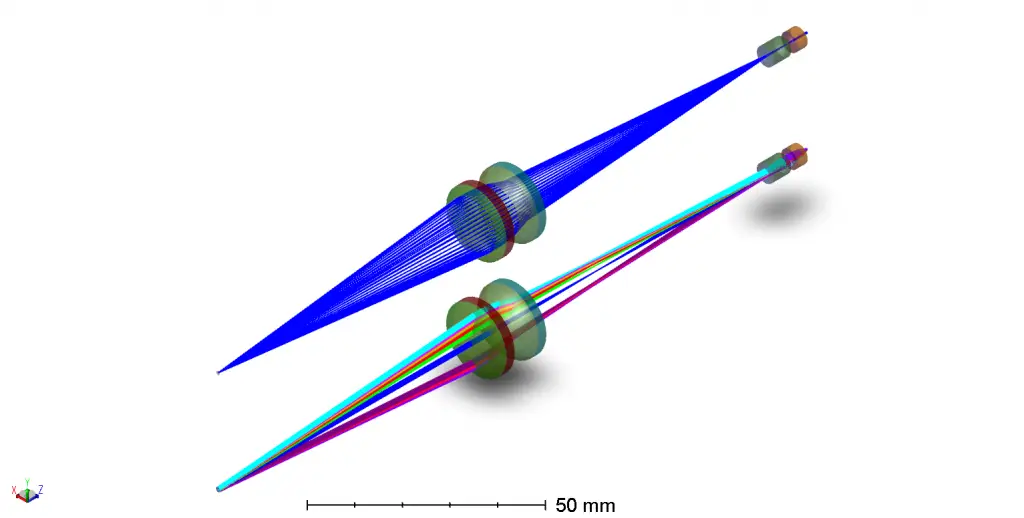
Nonlinear optics is the branch of optics that focuses on the behavior of light in nonlinear media. This article explains how to verify if a nonlinear optics double-pass system is set up correctly and how to identify any setup errors.
Understanding Double-Pass Systems in Nonlinear Optics
In sequential mode, rays are traced from one surface to another in a specific order. When modeling a double-pass system, the optical system needs to be modeled twice—once for each pass of the light. This setup ensures that the return path of the beam is accurately modeled, and different solve types such as position and pickup should be used to ensure proper mapping of the optics for the return path.
Special care must be taken when dealing with tolerancing, tilted, or decentered components, as the return path must be perturbed identically compared to the first pass. Ensuring this is done correctly is critical to achieving accurate results.
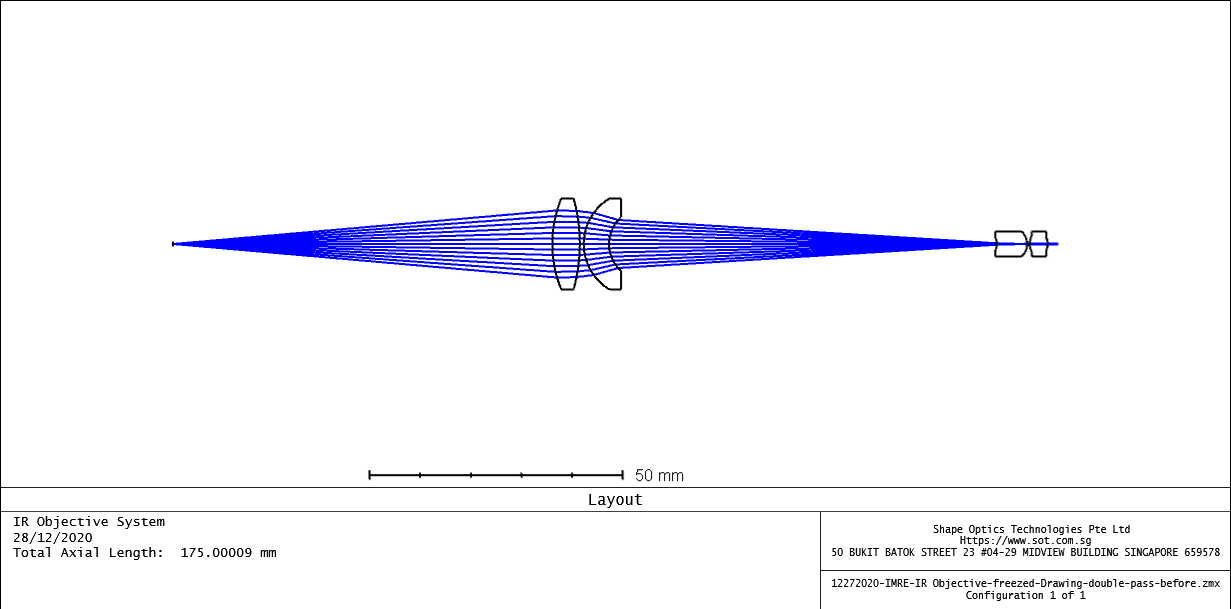
In this example, we demonstrate the process of testing a nonlinear optical double-pass system to ensure that aberrations are correctly accounted for and not merely artifacts caused by setup errors.

Zoom into details:
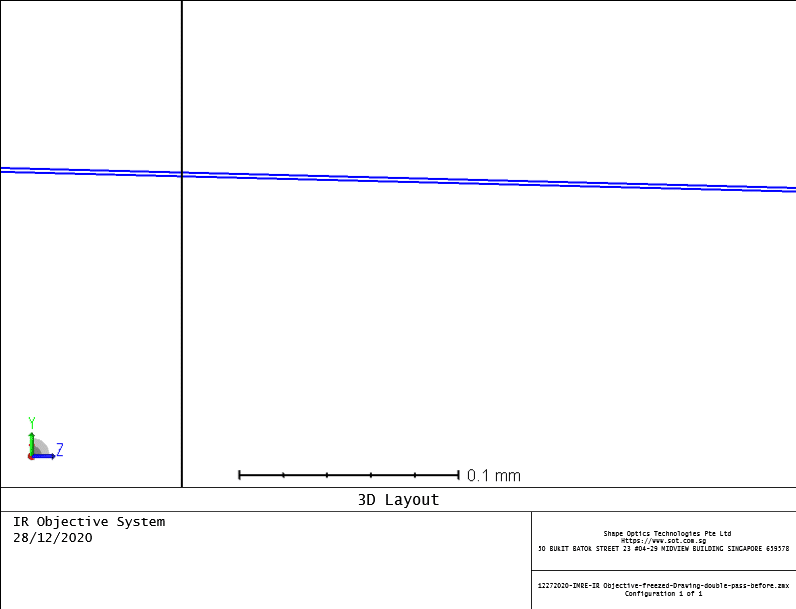
OpticStudio offers a ‘Retro Reflect’ surface type, which acts like a plane mirror but reflects rays exactly back along their incoming path. This feature ensures that rays follow the exact path they took on their first pass, meaning that on the second pass, the rays should converge to a perfect, unaberrated spot.


With this surface type selected, the aberrations are cancelled on the second pass, resulting in a perfect point image.
Even better, if you have made some mistake and you do not see perfect aberration correction, you can use Analysis…Rays & Spots…Single Ray Trace to trace a ray. The ray-trace data should be exactly the same on either side of the Retro Reflect surface, and when you identify a pair of surfaces that are not exactly the same, you have identified the setup problem:

As shown in the figure above, the angle and position is exactly the same on surface 9 and surface 14.
When performing tolerancing, a test run of the nonlinear optics double-pass system should be conducted with the double-pass mirror set as a retro-reflector. Tolerancing for RMS spot size will help identify errors in the setup:
- If the system and tolerance operands are correctly configured, the tolerancing criterion should be zero for all operands and Monte-Carlo files, regardless of the tolerance variations.
- Any non-zero results indicate errors in either the lens setup or the tolerance operands.
Reference
- Laikin, Milton. Lens Design. CRC Press, 2007.
- https://www.zemax.com/