
A longpass filter is an optical filter that allows wavelengths longer than a selected cut-on wavelength to pass through while blocking shorter wavelengths.
These optical filters are commonly used in imaging systems, biomedical instruments, fluorescence systems, fingerprint recognition, color measurement, environmental monitoring, optical sensors, and custom optical assemblies.
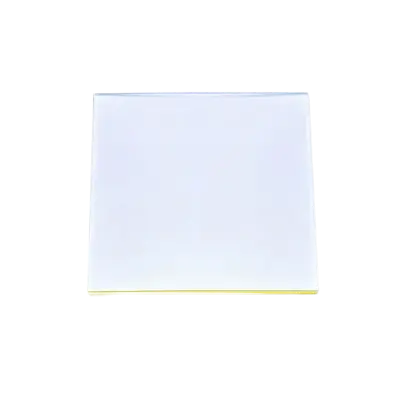
How Does a Longpass Filter Work?
A longpass filter is an optical filter that allows wavelengths longer than a selected cut-on wavelength to pass through while blocking shorter wavelengths.
In simple terms, it works as a wavelength separator. Light above the cut-on wavelength is transmitted, while light below this point is reduced or blocked.
The wavelength at which transmission begins is called the cut-on wavelength. For example, a 650 nm filter is designed to block wavelengths below its transition region while transmitting longer wavelengths above it.
These filters are widely used in fluorescence imaging, biomedical instruments, machine vision, biometric systems, optical sensors, color measurement, environmental monitoring, and custom optical assemblies.
Why Are Longpass Filters Used?
These filters are used when an optical system needs to remove shorter wavelengths while retaining longer wavelengths. As a result, they can improve contrast, reduce unwanted background light, separate wavelength ranges, and improve detection accuracy.
Common applications include:
- Biomedical imaging
- Fluorescence imaging
- Fingerprint recognition
- Biometric systems
- Digital imaging
- Color measurement
- Environmental monitoring
- Optical sensors
- Machine vision
- Scientific instruments
- Custom optical assemblies
Transmission and Blocking Regions
A longpass filter has two main regions:
| Region | Function |
|---|---|
| Blocking Region | Blocks shorter wavelengths before the cut-on point |
| Transmission Region | Allows longer wavelengths after the cut-on point to pass through |
Between these two regions is a transition area, often called the spectral edge.
Therefore, a good filter design should provide high transmission in the passband together with strong blocking below the cut-on wavelength
Key Longpass Filter Specifications
When selecting this type of filter, customers usually need to consider several key specifications.
| Specification | Simple Explanation |
|---|---|
| Cut-On Wavelength | The wavelength where the filter starts to transmit light |
| Transmission Range | The wavelength range that passes through the filter |
| Blocking Range | The shorter wavelength range that should be blocked |
| Transmittance | How much light passes through in the transmission range |
| Optical Density / OD | How strongly unwanted wavelengths are blocked |
| Substrate Material | The base optical material of the filter |
| Size and Thickness | Physical dimensions of the filter |
| Angle of Incidence | The angle at which light enters the filter |
| Coating Requirement | Filter coating design based on wavelength and application |
Common Types of Optical Longpass Filters
Longpass filters can be supplied in standard or customized designs depending on the required wavelength range and system use.
Common types include:
- UV longpass filters
- Visible longpass filters
- NIR longpass filters
- High-transmission longpass filters
- High-OD longpass filters
- Custom longpass filters
Longpass vs Shortpass vs Bandpass Filters
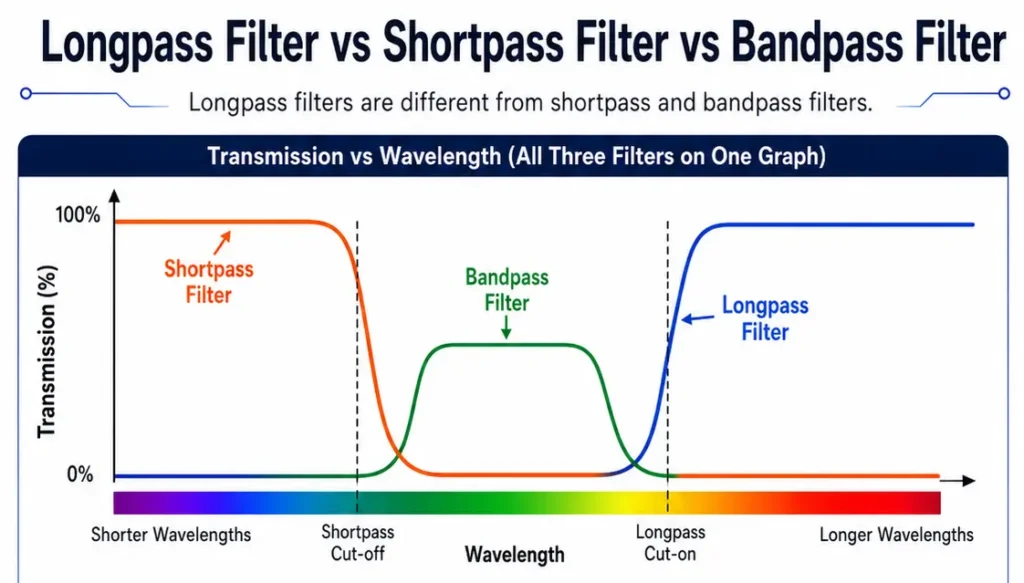
Longpass filters are different from shortpass and bandpass filters.
| Filter Type | What It Transmits | What It Blocks | Simple Explanation |
|---|---|---|---|
| Longpass Filter | Longer wavelengths | Shorter wavelengths | Allows light after the cut-on wavelength to pass |
| Shortpass Filter | Shorter wavelengths | Longer wavelengths | Allows light before the cut-off wavelength to pass |
| Bandpass Filter | A selected wavelength band | Wavelengths outside the band | Allows only a specific wavelength range to pass |
In simple terms:
A longpass filter keeps the longer wavelengths.
A shortpass filter keeps the shorter wavelengths.
A bandpass filter keeps only a selected middle wavelength range.
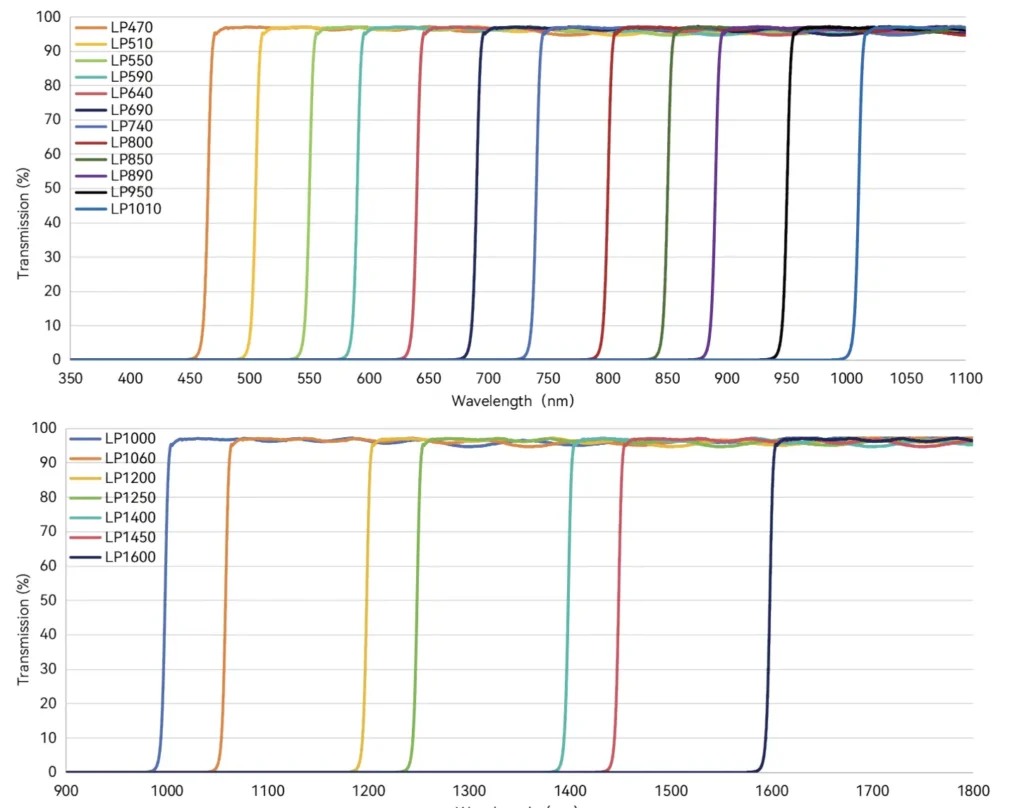
Typical Filter Specifications
| Item | Example Specification |
|---|---|
| Filter Type | Longpass filter |
| Cut-On Wavelength | 400 nm / 650 nm / 850 nm / custom |
| Transmittance | T ≥ 90%, or based on requirement |
| Blocking Range | Based on cut-on wavelength and application |
| Optical Density | OD2 / OD4 / OD6, or custom |
| Substrate | Optical glass / fused silica / custom material |
| Shape | Round / square / rectangular |
| Size | Ø25 mm / 50 × 50 mm / custom |
| Thickness | 1.0 mm / 2.0 mm / custom |
| Coating | Longpass filter coating |
| Mounting | Unmounted / mounted / custom ring |
| Application | Imaging / sensing / fluorescence / biometrics / color measurement |
Applications of Longpass Filters
| Application | How Longpass Filter Helps |
|---|---|
| Biomedical Imaging | Helps suppress unwanted background light and improve image contrast |
| Fluorescence Imaging | Blocks excitation light and transmits longer wavelength emission light |
| Fingerprint Recognition | Helps improve feature-to-background contrast |
| Digital Imaging | Supports wavelength separation and image quality control |
| Color Measurement | Helps select the required spectral range for measurement |
| Environmental Monitoring | Supports selective wavelength filtering for sensing applications |
| Machine Vision | Helps improve contrast under controlled lighting conditions |
| Optical Sensors | Helps reduce unwanted wavelengths and improve detection accuracy |
What Information Should You Provide Before Requesting a Quote?
To request a custom filter, it is helpful to provide:
- Required cut-on wavelength
- Transmission wavelength range
- Blocking wavelength range
- Transmittance requirement
- Optical density, or OD requirement
- Filter size and thickness
- Shape: round, square, rectangular, or custom
- Substrate material, if required
- Angle of incidence
- Surface quality requirement
- Quantity
- Mounted or unmounted requirement
- Application, such as imaging, fluorescence, sensing, or biometrics
- Drawing or specification, if available
If you are not sure which filter is suitable, you can provide your application and target wavelength range. Our team can help review the requirement and suggest a suitable filter option.
Conclusion
A longpass filter is used to transmit longer wavelengths and block shorter wavelengths.
It is commonly used in imaging, fluorescence, biomedical instruments, fingerprint recognition, color measurement, environmental monitoring, optical sensors, and custom optical systems.
The right wavelength filter depends on the cut-on wavelength, transmission range, blocking range, OD level, size, substrate, angle of incidence, and final application.
Shape Optics Technologies supplies longpass filters, shortpass filters, bandpass filters, optical coatings, coated filters, and custom optical filter components based on customer requirements.
Contact us to discuss your custom optical filter requirements.