
What Is a CaF2 (Calcium Fluoride) Window?
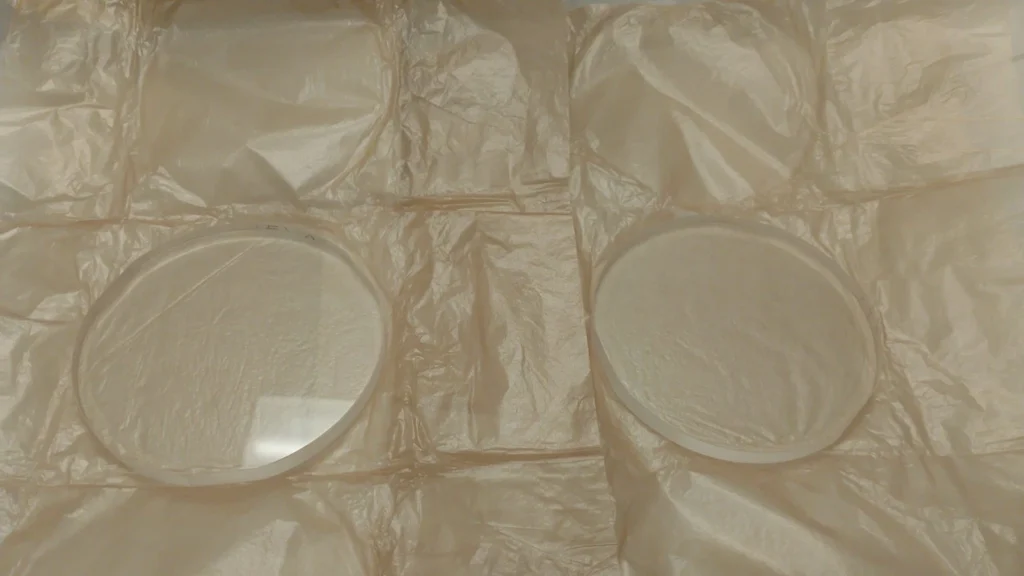
A CaF2 window, also known as a calcium fluoride window, is a flat optical component that transmits light while protecting sensitive parts inside an optical system. Designers commonly use this material in ultraviolet, visible, and infrared equipment because it supports a broad spectral range.
Unlike a lens, an optical window does not normally focus or magnify light. Instead, it provides a clear barrier between the external environment and components such as sensors, detectors, lenses, laser cavities, or vacuum chambers.
Because of its optical properties, calcium fluoride is widely used in spectroscopy, laser systems, scientific instruments, imaging equipment, gas analysis systems, and custom optical assemblies.
How Does a CaF2 Window Work?
A CaF2 window allows selected wavelengths to pass through the optical path with minimal absorption. At the same time, it helps protect the internal assembly from dust, contact, pressure differences, contamination, or environmental exposure.
For example, a spectroscopy instrument may use a calcium fluoride optical window to transmit ultraviolet or infrared signals into a measurement chamber. Similarly, a laser instrument may place the window in front of sensitive internal optics so the beam can pass through without leaving the system open to the environment.
The window is normally flat and parallel. However, designers may specify a wedged version when they need to reduce interference fringes, ghost reflections, or etalon effects.
Why Choose a Calcium Fluoride Optical Window?
One of the main advantages of calcium fluoride is its broad optical transmission. Depending on the material grade, thickness, surface finish, and operating conditions, optical-grade CaF₂ can support applications from the ultraviolet region into the infrared.
The calcium fluoride standard covers calcium fluoride used from 0.78 µm to 10 µm. It also notes that the material can transmit light in ultraviolet and visible regions.
In addition, CaF₂ has a relatively low refractive index. Therefore, an uncoated component may provide acceptable performance in some broadband systems. Nevertheless, an anti-reflection coating can further reduce reflection when the application targets a specific wavelength range.
Another useful feature is optical isotropy. Since calcium fluoride has a cubic crystal structure, it does not introduce birefringence in the same way as some anisotropic optical crystals. This property can benefit precision imaging, spectroscopy, and laser applications.
You can also review our Calcium Fluoride optical material and component capabilities for additional technical information.
Common Applications of CaF2 Windows
Engineers use calcium fluoride windows in many optical systems, including:
- UV spectroscopy and analytical instruments
- Visible-light optical equipment
- MWIR and broadband infrared systems
- Excimer and other laser systems
- Gas detection and environmental analysis
- Scientific and laboratory instruments
- Optical sensors and detector assemblies
- Vacuum chamber viewports
- Imaging and inspection systems
- Astronomy and precision research equipment
- Custom optical and opto-mechanical assemblies
For instance, UV-grade material may support excimer laser or ultraviolet measurement systems. Meanwhile, infrared-grade material may suit spectroscopy, gas analysis, cooled imaging, or other IR instruments.
In a laser or optical instrument, it may be used as a protective window to allow the beam or signal to pass through while protecting the internal optical path.
CaF2 Windows for UV, Visible, and Infrared Systems
A broadband optical system may need one substrate that works across more than one wavelength region. In this situation, a CaF2 window can offer a practical solution.
However, the usable range depends on more than the material name. The supplier should also confirm the optical grade, thickness, purity, coating, surface quality, and transmission requirement.
For example, VUV-grade material and IR-grade material may not provide the same performance at the shortest ultraviolet wavelengths.
Therefore, the quotation request should always state the actual working wavelength instead of using only general terms such as “UV” or “IR.” A precise range allows the engineering team to select the correct material grade and coating design.
CaF2 Window vs CaF2 Lens
A window and a lens serve different functions.
A CaF2 window normally has flat surfaces and mainly provides transmission and protection. It usually has little or no optical power.
By contrast, a CaF₂ lens has one or more curved surfaces. The curved geometry focuses, collimates, expands, or otherwise controls the light.
| Component | Main Function | Typical Surface |
|---|---|---|
| Calcium fluoride window | Protects the system and transmits light | Flat or wedged |
| Calcium fluoride lens | Focuses or controls light | Curved, spherical, or aspherical |
In simple terms, a window may suit an optical system that only needs a transparent protective barrier. However, a system that needs to form an image or control a beam will normally require a lens.
CaF2 Window Coating Options
Calcium fluoride components can use an uncoated surface or a coating designed for a specific wavelength band.
Uncoated Calcium Fluoride Window
An uncoated component may suit broadband applications, early prototypes, laboratory use, or systems that can accept the natural surface reflection.
Shape Optics offers standard and custom uncoated calcium fluoride windows in several sizes.
AR-Coated CaF₂ Window
An anti-reflection coating can improve transmission and reduce unwanted reflections within a selected wavelength range. For example, UV-VIS, NIR, or MWIR coating designs may support different optical systems.
You can view our UV-VIS coated CaF₂ window and other options in the complete CaF2 window product range.
Before selecting a coating, provide the following details:
- Operating wavelength range
- Required average or absolute reflectance
- Angle of incidence
- Polarization, when relevant
- Laser type, pulse duration, and energy level
- Operating temperature
- Environmental exposure
- Whether one or both surfaces require coating
A coating designed for the wrong wavelength or angle may reduce performance instead of improving it. Therefore, the optical and coating specifications should match the final system.
Handling and Mounting Considerations
Calcium fluoride requires careful handling because it is softer and more susceptible to scratching than many common optical glasses.
Sudden temperature changes, excessive mounting pressure, poor edge support, or incorrect cleaning methods may also damage the component.
To reduce these risks:
- Handle the optic by its edges
- Wear clean, powder-free gloves or finger cots
- Keep metal tools away from polished surfaces
- Use suitable optical cleaning materials
- Include a protective bevel or chamfer
- Avoid excessive clamp pressure
- Allow enough space for thermal expansion
- Pack each component separately during transport
In addition, the mount should support the window evenly without creating concentrated stress. Large, thin, or precision-grade windows may require a more detailed mechanical review.
What Information Is Needed for a Quotation?
A complete specification helps the supplier evaluate the material grade, manufacturability, coating, inspection requirements, cost, and lead time.
Please provide:
- Diameter, length, or width
- Shape, such as round, square, rectangular, or custom
- Thickness
- Dimensional tolerances
- Working wavelength range
- Surface quality
- Surface flatness
- Parallelism or wedge angle
- Clear aperture
- Coating requirement
- Edge or chamfer requirement
- Quantity
- Operating temperature and environment
- Laser parameters, when applicable
- Drawing, CAD file, or technical specification
- Final application
When some details are not yet fixed, share the intended application and target wavelength first. The engineering team can then recommend a practical starting specification.
Example Specification for CaF₂ Window
| Item | Example Specification |
|---|---|
| Material | Calcium Fluoride / CaF2 |
| Component Type | Optical window |
| Shape | Round flat window |
| Diameter | 25.00 mm +0.00 / -0.10 mm |
| Thickness | 3.00 mm ±0.10 mm |
| Wavelength Range | UV / Visible / IR / Custom range |
| Surface Quality | 60/40 scratch-dig |
| Surface Flatness | λ/2 @ 632.8 nm |
| Clear Aperture | ≥ 90% of diameter |
| Coating Requirement | Uncoated / AR coating / Custom coating |
| Edge / Chamfer | Protective chamfer, 0.2 mm × 45° |
| Quantity | 10 pcs |
| Application | Spectroscopy / laser system / optical instrument / infrared system |
The final specification may change according to the diameter, thickness, wavelength, coating, environmental requirements, and inspection method.
Conclusion
A CaF2 window provides a useful combination of broadband transmission and optical protection for UV, visible, and infrared equipment.
Engineers commonly select calcium fluoride optics for spectroscopy, laser systems, imaging, scientific instruments, gas analysis, vacuum systems, and custom optical assemblies.
Shape Optics Technologies supplies custom calcium fluoride windows, lenses, crystal blanks, coated optics, and other precision optical components based on customer drawings and application requirements.
Contact us to discuss your custom CaF₂ Calcium Fluoride window requirements.