
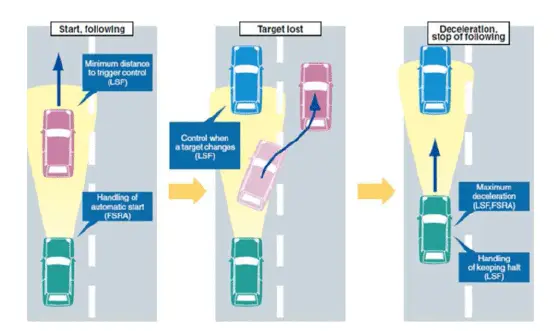
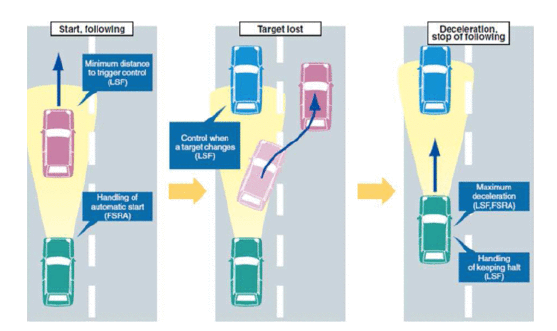
Selecting the right LiDAR sensor technology is a critical decision in Advanced Driver Assistance Systems (ADAS) and autonomous driving. As highly automated driving moves closer to large-scale deployment, safety remains the primary concern. Autonomous vehicles rely on three core functional pillars:
- Environment sensing (perception)
- Behavior planning
- Motion execution
Among these, perception is the most technically challenging due to dynamic traffic scenarios, unpredictable objects, and rapidly changing environmental conditions. LiDAR plays a central role in overcoming these challenges by providing accurate, real-time spatial information that complements cameras and radar.
Artificial Vision (Camera-Based Perception)
Camera-based artificial vision is widely used in robotics, surveillance, and automotive systems due to its low cost and rich semantic information. Cameras provide high-resolution spatial and color data that is valuable for object classification, lane detection, and traffic sign recognition.
Challenges in ADAS
Camera performance degrades under:
- Strong glare or shadows
- Low-light or nighttime conditions
- Rapid transitions between bright and dark environments
To address these issues:
- Near-infrared (NIR) and far-infrared (FIR) cameras improve visibility in darkness
- High Dynamic Range (HDR) sensors mitigate extreme lighting contrasts
- Automotive-grade image sensors now integrate HDR + NIR sensitivity for improved robustness
However, cameras fundamentally lack direct depth measurement, which limits their reliability in safety-critical scenarios.
3D Vision Technologies
3D vision systems extend traditional 2D imaging by adding depth perception, which is essential for automotive applications.
1. Stereo Vision
Principle: Uses two spatially separated cameras to estimate depth from disparity.
Advantages
- Produces dense depth maps
- Effective in textured environments
- Passive sensing (no active emission)
Disadvantages
- Poor performance on low-texture or uniform surfaces
- Requires precise calibration
- Struggles with sparse depth features
2. Structured Light
Principle: Projects a known infrared pattern and measures distortions to infer depth.
Advantages
- Less dependent on surface texture
- Lower computational complexity
- Reliable in controlled environments
Disadvantages
- Limited range (typically <20 m)
- Sensitive to ambient light
- Pattern distortion from reflections
3. Time-of-Flight (ToF)
Principle: Measures round-trip time of emitted IR light.
Advantages
- High refresh rates (>50 Hz)
- Robust in low-light environments
- Direct depth measurement
Disadvantages
- Limited outdoor range (10–20 m)
- Sunlight interference
- Extended range increases cost and complexity
Emerging Vision Sensors
Event-Based Vision
Event cameras respond asynchronously to intensity changes rather than capturing full frames.
Key Benefits
- Extremely high dynamic range (~120 dB)
- Sub-microsecond temporal resolution
- Efficient for SLAM and visual odometry
- Reduced CPU workload
Polarization Imaging
Research sensors capture polarization information to:
- Improve visibility in fog, rain, and glare
- Extract material properties
- Detect water, ice, or road conditions
Radar Technology in ADAS
Automotive radar typically uses FMCW (Frequency-Modulated Continuous Wave) operation and beamforming.
Advantages
- Robust in rain, fog, snow, and dust
- Long range (up to ~250 m)
- Measures both distance and velocity via Doppler
Challenges
- Limited angular and spatial resolution
- Difficulty separating closely spaced objects
- Sensitivity to object reflectivity
Emerging Radar
- High-frequency radars (≈90 GHz)
- High-resolution radar imaging
- Synthetic aperture radar (SAR) concepts
- Advanced antenna materials and layouts
LiDAR Technology for ADAS
LiDAR (Light Detection and Ranging) uses near-infrared laser pulses to directly measure distance via time-of-flight.
Core Capabilities
- Accurate range measurement (up to ~200 m)
- Generation of precise 3D point clouds
- Multi-layer scanning for environmental modeling
Advantages
- High spatial accuracy and resolution
- Reliable depth perception
- Works day and night
- Excellent for static object detection and mapping
Drawbacks
- Performance degradation in rain and fog
- Limited vertical resolution in low-cost systems (<16 layers)
- Sparse point clouds at long range
- Reduced detection of dark or specular surfaces
- Higher cost and power consumption
Emerging LiDAR Technologies
FMCW LiDAR
- Measures velocity directly via Doppler shift
- Improves object tracking and behavior prediction
- Enhanced immunity to ambient light
Solid-State LiDAR
Includes:
- MEMS micromirrors
- Optical phased arrays (OPA)
Benefits
- No mechanical rotation
- Faster scanning
- Dynamic beam shaping
- Random and adaptive scan patterns
- Improved long-range resolution
OPA-based LiDAR enables dense, adaptive scanning across the full field of view, supporting advanced ADAS functions.
Radar vs LiDAR Comparison for ADAS
| Feature | Radar | LiDAR |
|---|---|---|
| Sensing Method | RF waves | Laser pulses |
| Range | Up to ~250 m | Up to ~200 m |
| Weather Performance | Excellent | Degrades in fog/rain |
| Spatial Resolution | Moderate | High |
| Velocity Measurement | Direct (Doppler) | FMCW only |
| Object Separation | Limited | Excellent |
| Cost | Lower | Higher |
| 3D Mapping | Limited | Excellent |
Summary: Why LiDAR Is Essential for ADAS
LiDAR provides high-accuracy, real-time 3D environmental perception that is difficult to achieve with cameras or radar alone. Its ability to directly measure depth, detect small objects, operate in darkness, and generate precise 3D maps makes it a cornerstone sensor for ADAS and autonomous driving.
While LiDAR has limitations—particularly in adverse weather and cost—ongoing advancements in solid-state, FMCW, and OPA-based architectures continue to improve its performance and scalability.
For ADAS applications, the optimal solution is sensor fusion, where LiDAR complements cameras and radar to deliver robust, redundant, and safe perception.