


Developing a custom optical component requires more than selecting the right material or dimensions. Optical performance, manufacturing tolerances, surface quality, coating requirements, and operating conditions all play an important role in determining whether a component meets its intended application.
At Shape Optics Technologies (SOT), we support customers throughout the development and manufacturing process, from initial requirement evaluation and optical material selection to precision fabrication, coating, quality inspection, and final delivery.
Whether your project requires an optical window, lens, dome, blank, optical filter, or specialized coated component, our structured approach helps ensure that technical specifications are carefully reviewed before production.
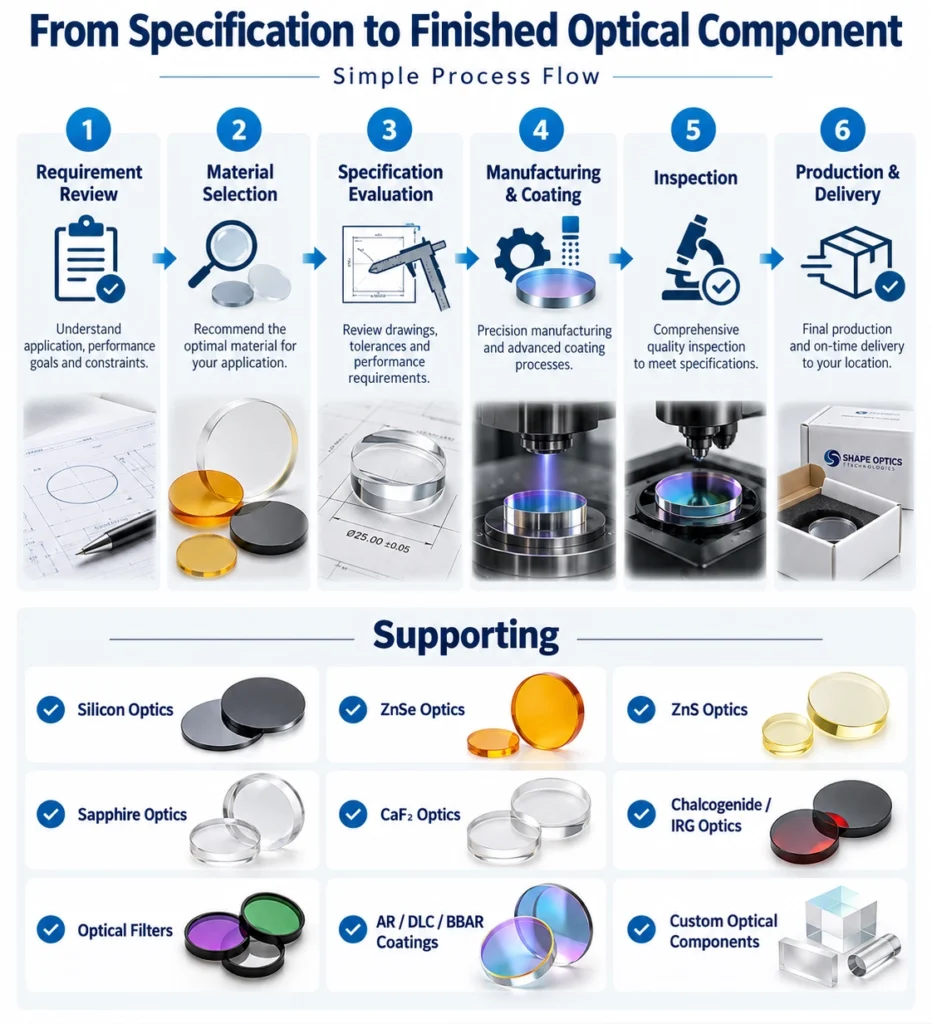
Step 1: Understand Your Optical Requirements
Every custom optical component project begins with understanding the application and technical requirements.
Different optical systems demand different material properties, optical performance, and manufacturing tolerances. Establishing these requirements early helps identify suitable materials and manufacturing methods.
Key parameters to define:
Component type: Optical window, lens, blank, dome, filter, or custom component.
Material requirements: Preferred optical material or acceptable alternatives.
Dimensions and tolerances: Diameter, thickness, length, width, and dimensional accuracy.
Operating wavelength: UV, visible, near-infrared, mid-infrared, or long-wave infrared.
Surface quality: Required scratch-dig specification and surface finish.
Order quantity: Prototype, small-batch, or production quantities.
Application environment: Temperature, humidity, mechanical stress, and other operating conditions.
Understanding these specifications allows our team to evaluate manufacturing feasibility and determine the most suitable approach for each project.
Step 2: Select the Right Optical Material
Selecting the appropriate optical material is an important step in custom optical component development.
Each material offers different optical transmission characteristics, mechanical properties, thermal behavior, and manufacturing considerations.
At SOT, we support a wide range of optical materials for infrared, visible, and ultraviolet applications.
Common Optical Materials
| Material | Typical Applications |
|---|---|
| Silicon (Si) | Infrared windows, lenses, and optical components |
| Zinc Selenide (ZnSe) | CO₂ laser optics, infrared windows, and lenses |
| Zinc Sulfide (ZnS) | Infrared windows, protective optics, and multispectral applications |
| Sapphire (Al2O3) | Protective windows, high-strength optics, and harsh-environment applications |
| Calcium Fluoride (CaF2) | UV, visible, and infrared optical components |
| Chalcogenide Glass / IRG | Infrared lenses and customized optical systems |
| Fused Silica | UV and visible optical windows, lenses, and precision optics |
| Optical Glass | Imaging lenses, optical instruments, and other optical assemblies |
Material selection depends on several factors, including the operating wavelength, transmission requirements, environmental conditions, mechanical strength, and coating compatibility.
For applications where the initial material selection may not be optimal, alternative optical materials can also be evaluated based on the technical requirements.
Step 3: Review Optical & Mechanical Specifications
Before manufacturing begins, the optical and mechanical specifications are reviewed to evaluate feasibility and confirm the required component characteristics.
This stage helps identify potential challenges associated with dimensional accuracy, surface quality, optical performance, and coating requirements.
Key Specifications for Evaluation
| Parameter | Review Considerations |
|---|---|
| Dimensions | Diameter, length, width, and overall geometry |
| Thickness | Nominal thickness and allowable tolerance |
| Surface Quality | Scratch-dig requirements and surface defects |
| Surface Flatness | Required flatness or surface figure |
| Parallelism / Wedge | Angular tolerance between optical surfaces |
| Clear Aperture | Effective optical area required for performance |
| Radius / Surface Profile | Curvature and geometry for spherical or aspherical lenses |
| Coating Specifications | Wavelength range, transmission, reflection, and durability |
| Mechanical Tolerances | Edge treatment, chamfer, centering, and mounting dimensions |
Technical Documentation
Customers may submit the following documents for engineering evaluation:
2D optical or mechanical drawings (PDF/DWG/DXF)
3D CAD models, including STP/STEP files
Optical performance requirements
Material and coating specifications
Inspection and quality requirements
A detailed specification review helps reduce uncertainties before prototype development or production.
Step 4: Precision Manufacturing & Optical Coating
After the technical specifications are reviewed and approved, the manufacturing process can begin.
Precision optical manufacturing requires specialized equipment, appropriate fabrication techniques, and controlled processing to achieve the required dimensional and optical performance.
Optical Manufacturing Capabilities
At Shape Optics Technologies, our manufacturing capabilities include:
Cutting and shaping: Preparing optical material blanks according to the required dimensions.
CNC grinding: Producing optical surfaces and component geometries with controlled accuracy.
Precision polishing: Achieving specified optical surface quality and surface figure.
Lens fabrication: Manufacturing spherical, aspherical, and other custom optical elements.
Custom optical machining: Supporting specialized dimensions and mechanical configurations.
Optical coating: Applying functional coatings to meet transmission, reflection, or protection requirements.
Optical Coating Solutions
Different optical applications require different coating solutions to optimize performance and protect optical surfaces.
SOT supports various optical coating options, including:
AR (Antireflection) Coating: Reduces unwanted surface reflections across specified wavelengths.
DLC (Diamond-Like Carbon) Coating: Provides enhanced surface protection for selected infrared optical applications.
BBAR (Broadband Antireflection) Coating: Reduces reflections across a broader wavelength range.
Optical Filter Coatings: Used to achieve specified spectral transmission and blocking characteristics.
Custom Optical Coatings: Designed according to specialized wavelength and performance requirements.
Coating selection depends on the optical substrate, operating wavelength, environmental exposure, and required optical characteristics.
Types of Custom Optical Components
Our manufacturing support covers a wide range of products, including optical windows, spherical and aspherical lenses, infrared domes, optical blanks, optical filters, coated windows, and specialized components manufactured according to customer drawings.
Step 5: Inspection & Quality Verification
Inspection and quality verification are important stages of optical component manufacturing.
Finished components are inspected according to the agreed technical requirements to determine whether they meet the specified dimensions, surface characteristics, and optical performance criteria.
Typical Inspection Parameters
Dimensional inspection: Diameter, thickness, and dimensional tolerances.
Surface quality inspection: Scratch-dig and visible surface imperfections.
Surface flatness / figure: Verification using appropriate optical metrology methods.
Parallelism / wedge: Measurement of surface orientation and angular deviation.
Clear aperture: Verification of the effective optical area.
Coating inspection: Appearance and relevant coating performance.
Optical transmission: Spectral testing where specified.
Mechanical inspection: Edge quality, chamfer, and other specified dimensions.
Visual inspection: General component condition and workmanship.
Additional inspection or qualification testing can be arranged based on specific customer requirements and applicable standards.
Quality verification helps ensure that the manufactured components conform to the approved specifications before delivery.
Step 6: Production & Delivery
Following manufacturing and inspection, optical components proceed to packaging and delivery.
Shape Optics Technologies supports customers across different stages of product development, from prototype evaluation to small-batch orders and volume production.
Production Support Includes
Prototype manufacturing: Producing initial samples for testing and evaluation.
Small-batch production: Supporting limited-quantity and specialized optical requirements.
Volume production: Manufacturing optical components according to approved production specifications.
Custom packaging: Protecting delicate optical surfaces during handling and transportation.
Inspection documentation: Providing applicable quality and measurement records.
Material and coating documentation: Available according to project requirements.
International delivery: Supporting customers across different markets.
Manufactured components can undergo final inspection and quality verification before shipment to customers.
From Optical Requirements to Finished Components
Developing a custom optical component involves multiple engineering and manufacturing considerations, from selecting the appropriate optical material to confirming dimensions, surface specifications, and coating performance.
At Shape Optics Technologies, we support this process through material evaluation, technical specification review, precision manufacturing, optical coating, and quality verification.
Our capabilities cover a broad range of optical materials, including silicon, ZnSe, ZnS, sapphire, CaF₂, chalcogenide glass, fused silica, and other specialized optical materials.
By combining manufacturing capabilities with technical support, we help customers develop customized optical components for infrared imaging, laser systems, analytical instruments, and other demanding optical applications.
Looking for Custom Optical Components?
Whether you require optical windows, lenses, domes, filters, or precision-coated components, SOT can evaluate your technical requirements and support your project.
Send us your 2D drawing, 3D STP file, or technical specifications, along with the required quantity, for review.