
Description
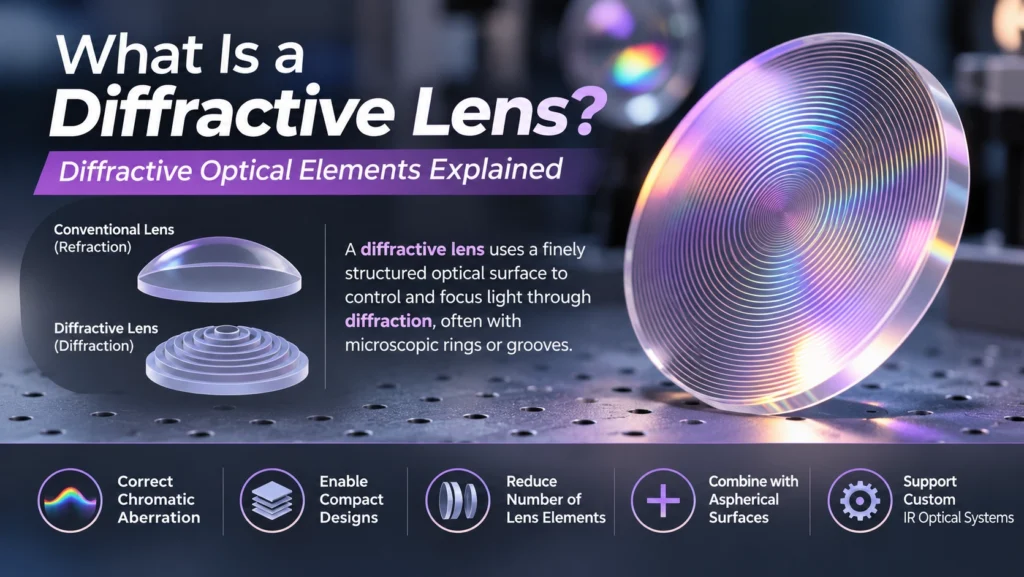
A diffractive lens is an optical component that uses a fine surface structure to control and focus light through diffraction.
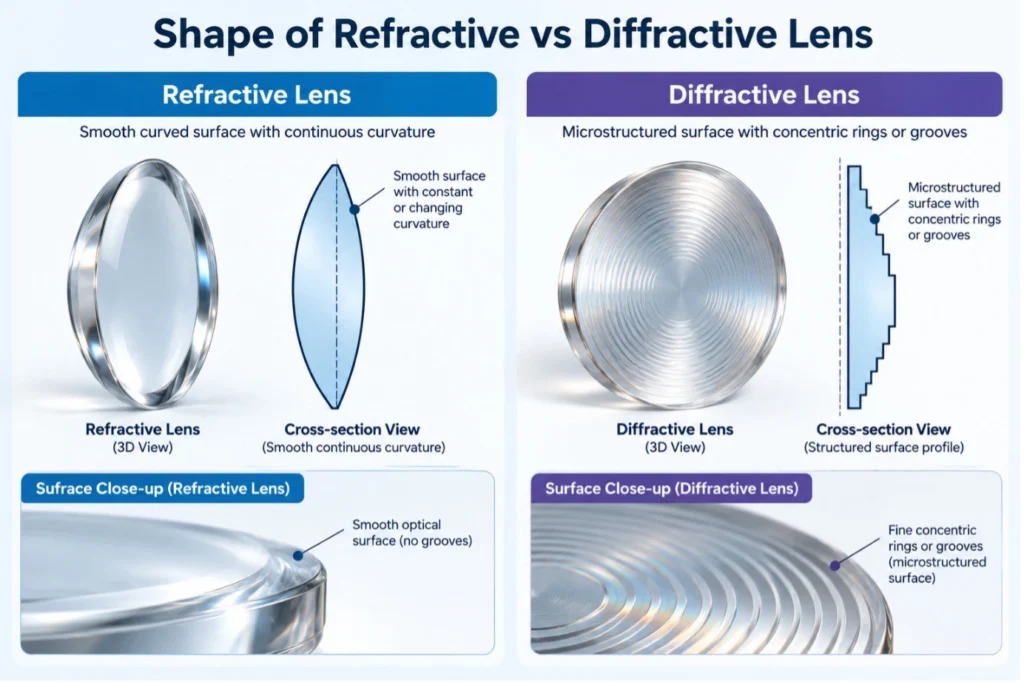
Unlike a conventional refractive lens, which mainly uses a curved surface and refractive index to bend light, a diffractive lens uses precisely designed microstructures or concentric grooves on the optical surface.
Diffractive surfaces can be used alone or combined with spherical or aspherical lenses to improve optical performance, correct chromatic aberration, and support more compact optical systems.
What Is a Diffractive Lens?
A diffractive lens is an optical lens that uses diffraction to control the direction of light.
Its optical surface contains a precisely designed pattern, usually made up of very fine concentric rings or grooves.
These surface structures change the phase of the light passing through the lens and guide the light toward a required focal point.
In simple terms:
A refractive lens focuses light mainly through its curved surface.
A diffractive lens focuses light through a specially designed microstructured surface.
Diffractive lenses are also commonly associated with Diffractive Optical Elements, or DOEs.
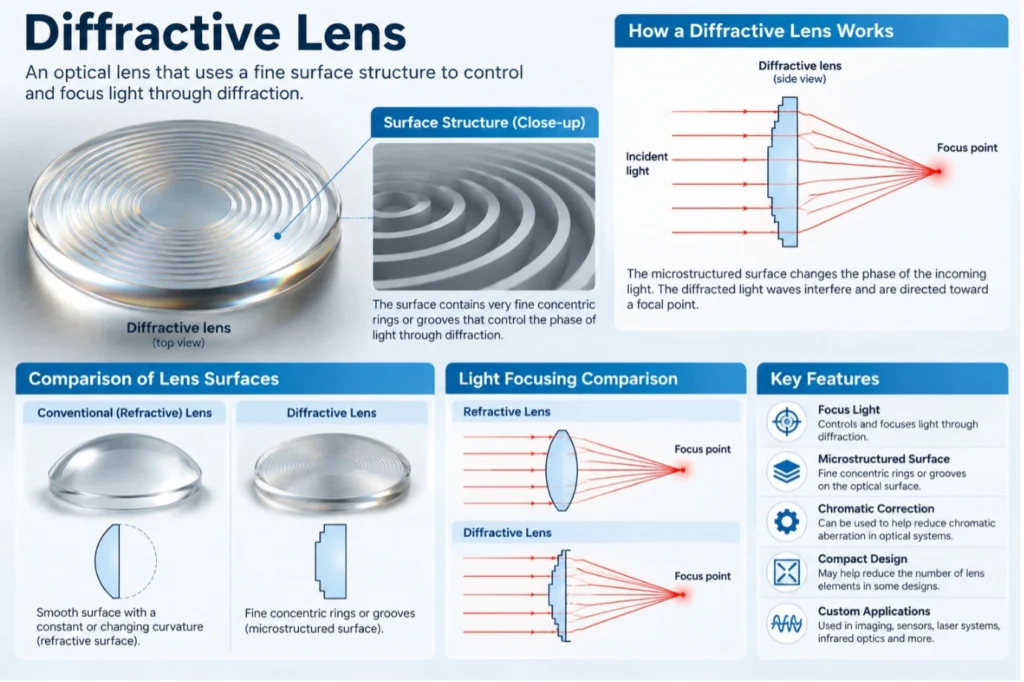
How Does a Diffractive Lens Work?
A normal refractive lens bends light because of the lens material and curved optical surface.
A diffractive lens works differently.
The surface contains many small optical zones or grooves. Each zone changes the phase of the incoming light.
Together, these zones cause the light waves to interfere and travel in the desired direction.
The diffractive structure can be designed to:
- Focus light
- Collimate light
- Correct optical aberrations
- Separate wavelengths
- Shape a beam
- Support compact optical systems
The exact groove structure depends on the wavelength and optical design.
What Does a Diffractive Lens Look Like?
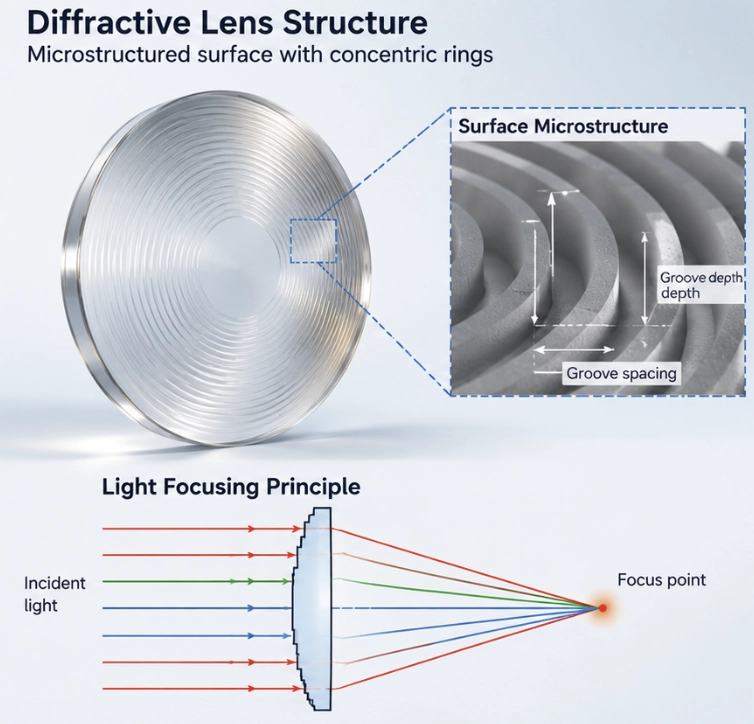
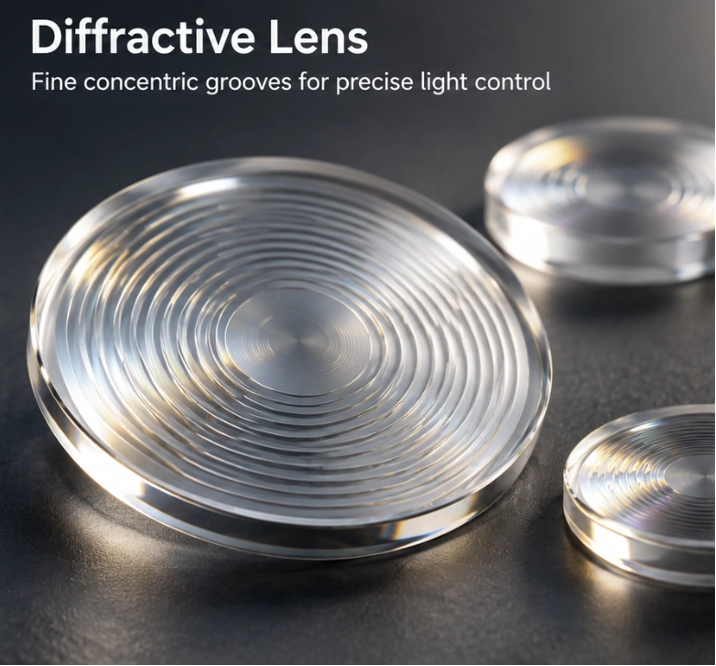
A diffractive lens may look similar to a normal optical lens from a distance.
However, under closer inspection, its surface may contain very fine circular or ring-like structures.
These structures can be much smaller than the overall lens diameter.
Common surface forms include:
- Concentric diffractive rings
- Multi-level phase structures
- Kinoform-type profiles
- Diffractive surface combined with an aspheric surface
- Custom DOE patterns
For many infrared applications, the diffractive structure can be manufactured directly onto the optical surface.
Diffractive Lens vs Refractive Lens
A diffractive lens and a conventional refractive lens control light in different ways.
| Item | Refractive Lens | Diffractive Lens |
|---|---|---|
| Main Principle | Refraction | Diffraction |
| Surface | Smooth curved surface | Fine microstructured surface |
| Light Control | Uses material refractive index and curvature | Uses phase changes from surface structures |
| Chromatic Behavior | Normal material dispersion | Strong wavelength-dependent diffraction |
| Typical Use | General focusing and imaging | Aberration correction, compact optics, beam control |
| Manufacturing | Grinding, polishing, molding, turning | Precision microstructure fabrication or diamond turning |
In some systems, refractive and diffractive functions are combined into one optical element.
What Is a Hybrid Refractive-Diffractive Lens?
A hybrid lens combines:
- A conventional refractive surface
- A diffractive optical surface
For example, one side of the lens may be an aspherical refractive surface while the other side includes a diffractive structure.
This type of design can provide additional optical correction without adding more lens elements.
A hybrid refractive-diffractive lens may help:
- Reduce chromatic aberration
- Reduce the number of lens elements
- Reduce lens length
- Reduce system weight
- Improve compact optical design
- Improve performance in selected wavelength ranges
This approach is especially useful in infrared optical systems where system size and number of elements are important.
Why Can Diffractive Optics Help Correct Chromatic Aberration?
Refractive and diffractive optical surfaces respond differently to wavelength.
A refractive lens changes focal behavior because the refractive index of the material varies with wavelength.
A diffractive surface also has wavelength-dependent focal behavior, but its dispersion can be used in the opposite direction to the refractive element.
By combining refractive and diffractive optical power, an optical designer can compensate for some wavelength-related focus shift.
This can help improve performance across a wider wavelength range.
Diffractive Lenses in Infrared Optics
Diffractive optical surfaces are often useful in infrared optical systems.
They may be used in:
- LWIR optical systems
- MWIR optical systems
- Thermal imaging lenses
- Infrared sensors
- Compact IR lens assemblies
- Laser systems
- Scientific instruments
- Custom infrared optical components
For infrared systems, diffractive structures may be manufactured on materials such as:
- Germanium
- Silicon
- Chalcogenide Glass
- ZnSe
- Other suitable infrared optical materials
The final material depends on wavelength range, optical performance, manufacturing method, and application.
Aspherical + Diffractive Lens
One useful design is an aspherical-diffractive lens.
This means the same lens may include:
- Aspherical surface geometry
- Diffractive microstructure
The aspherical surface helps control geometric aberrations.
The diffractive structure can help with wavelength-related correction or other optical functions.
This combination can be useful when the optical system needs high performance while keeping the number of lens elements low.
Advantages of Diffractive Lenses
Depending on the optical design, diffractive lenses may provide several advantages:
- Compact optical design
- Lower lens element count
- Chromatic aberration correction
- Lightweight optical assemblies
- Additional design flexibility
- Integration with aspherical surfaces
- Custom beam shaping or focusing
- Useful for infrared optical systems
However, these advantages depend strongly on the wavelength, design, manufacturing accuracy, and application.
Limitations of Diffractive Lenses
Diffractive lenses are not suitable for every optical system.
Important considerations include:
- Strong wavelength sensitivity
- Diffraction efficiency
- Groove accuracy
- Surface fabrication complexity
- Stray diffraction orders
- Surface inspection requirements
- Coating compatibility
A diffractive design should therefore be evaluated as part of the complete optical system.
Diffractive Lens vs Aspherical Lens
Diffractive and aspherical lenses are sometimes confused, but they are not the same.
| Item | Aspherical Lens | Diffractive Lens |
|---|---|---|
| Surface Principle | Changing curvature | Microstructured phase profile |
| Main Purpose | Correct geometric aberrations | Control light through diffraction |
| Surface Appearance | Smooth non-spherical curve | Fine grooves or rings |
| Chromatic Correction | Limited by refractive material | Can support chromatic correction in hybrid designs |
| Typical Manufacturing | Grinding, polishing, molding, diamond turning | Precision machining, lithography, molding, diamond turning |
| Can Be Combined? | Yes | Yes |
A single optical element can sometimes contain both aspherical and diffractive features.
Manufacturing Diffractive Optical Components
Diffractive optical surfaces require high manufacturing precision.
Depending on the material and design, manufacturing methods may include:
- Precision diamond turning
- Micro-machining
- Precision molding
- Lithographic processes
- CNC optical processing
- Custom surface fabrication
For infrared materials, diamond turning is commonly considered for suitable diffractive and aspherical surfaces.
After manufacturing, the component may require:
- Surface profile inspection
- Groove-depth measurement
- Dimensional inspection
- Optical testing
- Coating
- Final visual inspection
Coating Options
Diffractive optical components may also require coating.
Common coating options include:
- AR coating
- BBAR coating
- DLC coating for suitable IR applications
- Laser coatings
- Custom wavelength coatings
The coating design must consider the substrate material, groove structure, wavelength range, and application.
What Information Should You Provide Before Requesting a Quote?
For a custom diffractive lens or diffractive optical component, it is helpful to provide:
- Material
- Diameter
- Center thickness
- Wavelength range
- Focal length
- Diffractive surface location
- Groove depth
- Groove spacing or phase profile
- Diffraction order, if specified
- Aspheric coefficients, if applicable
- Surface quality
- Surface figure
- Clear aperture
- Coating requirement
- Quantity
- Application
- Optical drawing or design file
For an aspherical-diffractive lens, the complete surface equation, coefficients, and diffractive profile are especially important for evaluation.
Example Diffractive Lens Specification
| Item | Example Specification |
|---|---|
| Component | Aspherical + Diffractive Lens |
| Material | Chalcogenide Glass / Silicon / Germanium / Custom |
| Wavelength Range | MWIR / LWIR / Custom |
| Diameter | Based on drawing |
| Surface Type | Aspherical + Diffractive |
| Groove Depth | Based on optical design |
| Clear Aperture | Based on drawing |
| Surface Quality | 60/40 or project requirement |
| Coating | AR / BBAR / Custom |
| Quantity | Prototype / Batch production |
| Application | Infrared imaging / sensing / optical system |
Conclusion
A diffractive lens uses a precisely designed microstructured surface to control light through diffraction.
Unlike a conventional refractive lens, it relies on fine optical zones or grooves rather than only surface curvature.
Diffractive surfaces can be used alone or combined with spherical and aspherical surfaces.
In hybrid optical designs, they can help correct chromatic aberration, reduce lens element count, and support compact optical systems.
Shape Optics Technologies supports custom spherical, aspherical, and diffractive optical components for infrared, imaging, sensing, laser, and custom optical applications.
Contact us to discuss your custom diffractive lens or optical component requirements.