
Spherical vs Aspherical Lenses: What Is the Difference?
Spherical and aspherical lenses are two common types of optical lens components widely used in imaging, sensing, laser, infrared, scientific, and industrial optical systems.
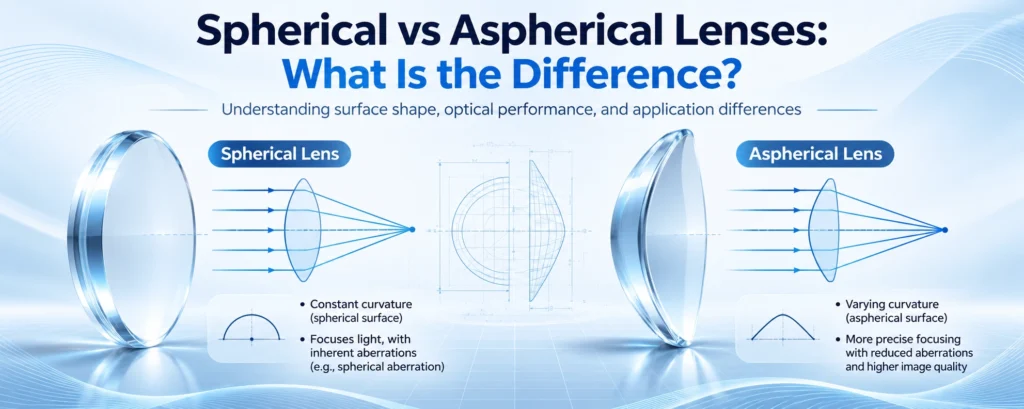
The main difference between them is the shape of the optical surface.
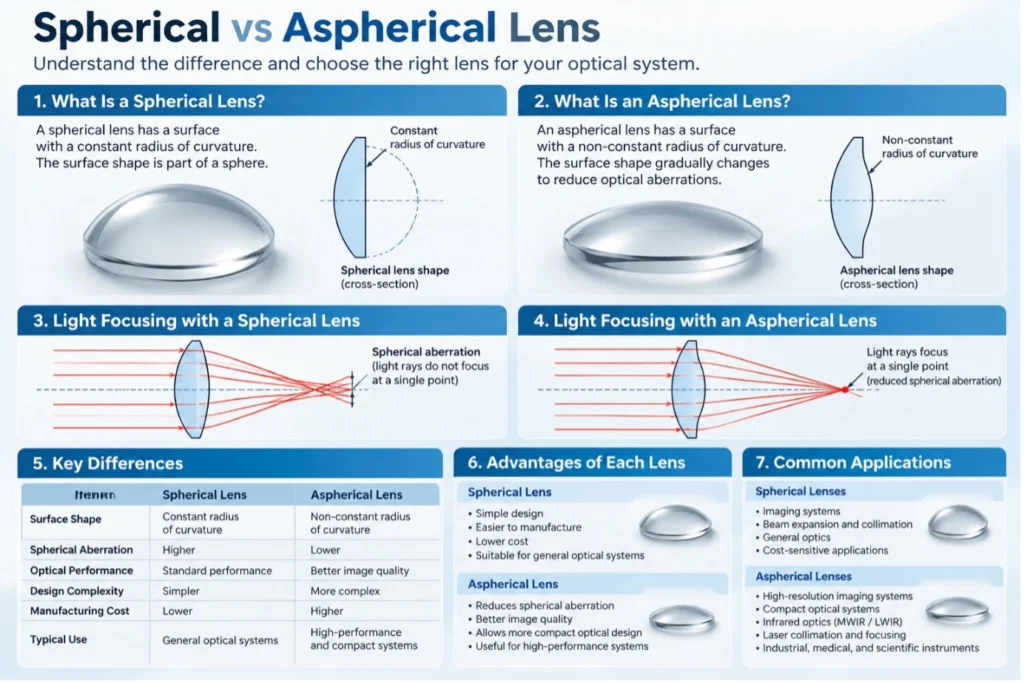
A spherical lens has a surface with a constant radius of curvature, while an aspherical lens has a more complex surface profile whose curvature changes from the center toward the edge.
This difference affects optical performance, aberration correction, manufacturing complexity, component cost, and the number of optical elements that may be required in an optical system.
Understanding the differences between spherical and aspherical lenses can help optical engineers and system designers select the most suitable components for their applications.
What Is a Spherical Lens?
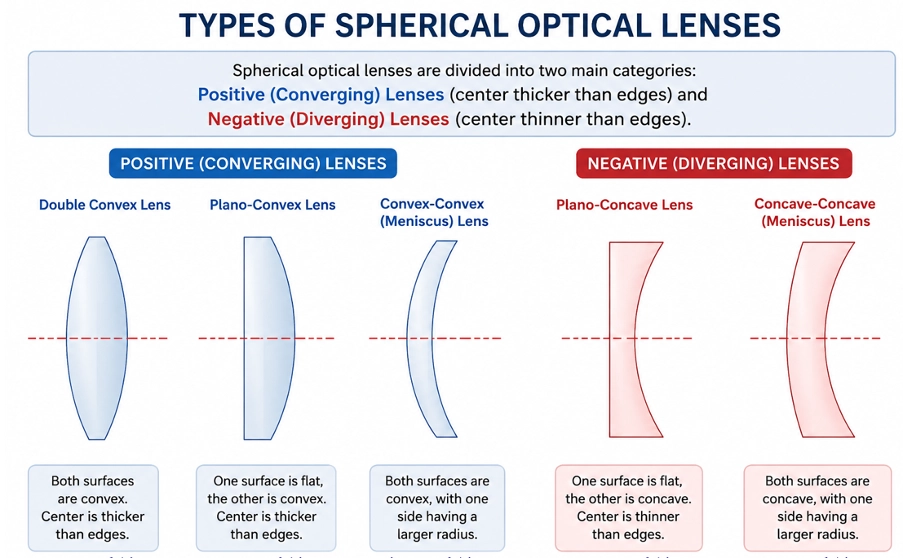
A spherical lens has one or more optical surfaces shaped as part of a sphere.
Because the surface has a constant radius of curvature, spherical lenses are widely used and can be manufactured using established optical grinding and polishing processes.
Common Types of Spherical Lenses
- Plano-convex lenses
- Bi-convex lenses
- Plano-concave lenses
- Bi-concave lenses
- Meniscus lenses
Applications of Spherical Lenses
Spherical lenses are commonly used in:
- Imaging systems
- Laser systems
- Optical sensors
- Optical instruments
- Infrared systems
- Scientific equipment
- Industrial optical assemblies
Spherical lenses are often selected for applications where conventional optical performance, established manufacturing processes, and cost efficiency are important considerations.
What Is an Aspherical Lens?
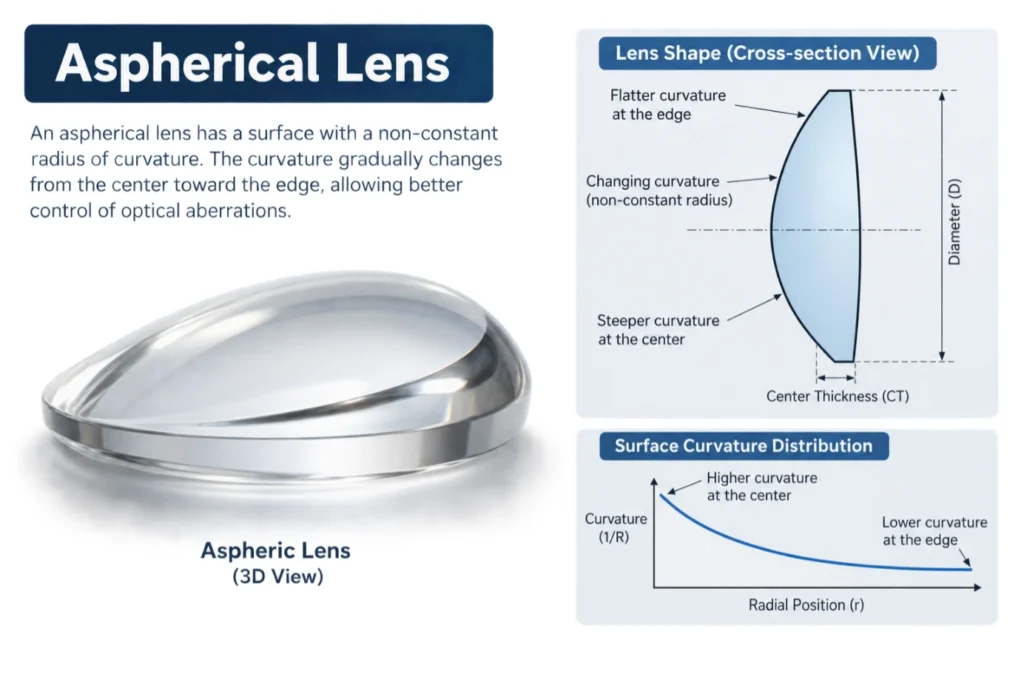
An aspherical lens has at least one optical surface that differs from a simple spherical curve.
Unlike a spherical lens, the curvature of an aspherical surface varies across its profile, allowing optical designers greater control over how light travels through the lens.
Advantages of Aspherical Lenses
Aspherical lenses can help:
- Reduce spherical aberration
- Improve focusing performance
- Improve image quality
- Reduce the number of optical elements in certain designs
- Support compact optical systems
- Reduce overall system weight in some applications
These characteristics make aspherical lenses particularly useful in high-performance imaging, infrared optics, laser systems, precision sensors, and compact optical assemblies.
What Is Spherical Aberration?
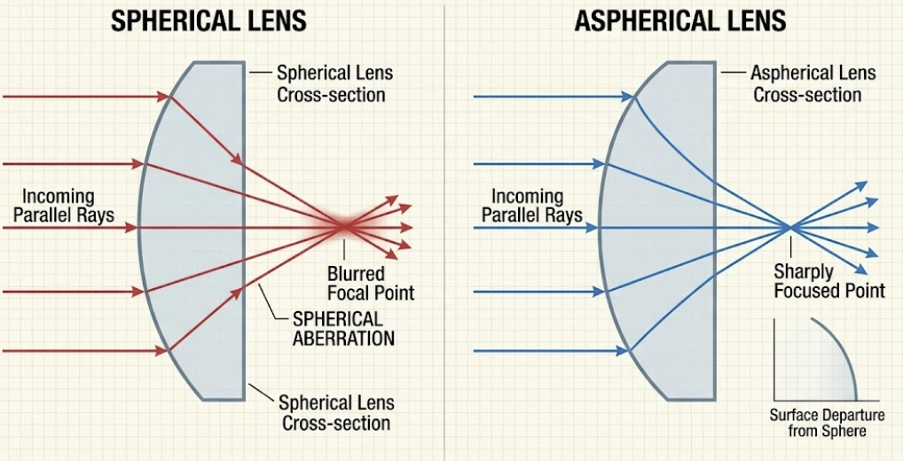
Spherical aberration is an optical phenomenon that occurs when light rays passing through different areas of a lens do not converge at exactly the same focal position.
For example, rays passing near the edge of a spherical lens may focus at a different position from rays traveling closer to its optical axis.
This can result in:
- Reduced image sharpness
- Blurred image details
- Lower focusing accuracy
- Reduced optical performance
An appropriately designed aspherical surface can control the light rays more precisely and help reduce spherical aberration.
This is one of the key reasons aspherical lenses are used in optical systems requiring high image quality or compact designs.
Spherical vs Aspherical Lens Comparison
| Property | Spherical Lens | Aspherical Lens |
|---|---|---|
| Surface Shape | Constant spherical curvature | Changing surface curvature |
| Manufacturing | Generally more straightforward | More complex |
| Optical Design | Conventional | Greater design flexibility |
| Spherical Aberration | May require additional correction | Can help reduce aberration |
| Lens Element Count | May require more elements | May reduce element count |
| Compact Design | Depends on the system | Can support compact designs |
| Inspection | Standard spherical inspection | Requires surface-profile inspection |
| Typical Cost | Generally lower for comparable simple parts | Generally higher due to complexity |
Both spherical and aspherical lenses have important roles in optical engineering. The best option depends on the required optical performance, application, manufacturing considerations, and system design.
Common Materials for Spherical and Aspherical Lenses
Optical lenses can be manufactured from various materials depending on the operating wavelength, application, environmental conditions, and optical requirements.
Common optical materials include:
- Optical Glass
- Fused Silica
- Silicon (Si)
- Zinc Selenide (ZnSe)
- Zinc Sulfide (ZnS)
- Chalcogenide Glass
- Calcium Fluoride (CaF₂)
- Sapphire (Al₂O₃)
- Other custom optical materials
Not every material is suitable for every lens geometry or manufacturing process.
The material selection and optical surface design should be evaluated together to ensure the required optical performance and manufacturability.
Spherical Lenses for Infrared Applications
Spherical infrared lenses may be manufactured from materials such as Silicon, Zinc Selenide, Zinc Sulfide, Chalcogenide Glass, and other suitable infrared optical materials.
These lenses can be used in:
- Infrared sensors
- Thermal imaging systems
- Infrared optical instruments
- Laser systems
- Detector assemblies
- Custom infrared optical systems
Depending on the optical requirements, multiple spherical elements may be combined to achieve the desired image quality, focal length, and aberration correction.
Aspherical Lenses for Infrared Applications
Aspherical lenses are widely used in infrared optical systems, particularly where optical performance, compact dimensions, and aberration correction are important.
Benefits of Aspherical Infrared Lenses
For suitable materials and optical designs, aspherical components may provide:
- Improved aberration correction
- More compact optical assemblies
- Reduced optical element count
- Improved imaging performance
- High-performance infrared focusing
- Reduced size and weight in certain systems
Manufacturing Methods
Depending on the selected material and optical specifications, aspherical infrared lenses may be produced using:
- Precision diamond turning
- CNC optical machining
- Precision optical polishing
- Precision molding for suitable Chalcogenide Glass materials
Manufacturing methods must be selected based on the material properties, surface geometry, dimensional tolerances, and required optical performance.
Manufacturing Spherical Lenses
Spherical lenses are generally manufactured using established optical fabrication processes.
Depending on the material and component specifications, the production process may include:
- Material cutting
- Rough grinding
- Fine grinding
- Optical polishing
- Centering
- Edge processing
- Optical coating
- Final inspection
Common Quality Inspection Requirements
- Diameter
- Center thickness
- Radius of curvature
- Surface quality
- Surface figure
- Centration
- Coating performance
Consistent manufacturing and optical inspection help ensure that spherical lenses meet the required dimensional and optical specifications.
Manufacturing Aspherical Lenses
Aspherical lenses generally require more advanced manufacturing and measurement processes because of their complex optical surface profiles.
Depending on the material and design, the manufacturing process may include:
- Precision diamond turning
- CNC optical machining
- Precision molding
- Precision grinding and polishing
- Aspheric surface-profile measurement
- Optical coating
- Final optical inspection
Aspherical lens production requires accurate control of surface geometry and optical tolerances.
Surface-profile measurement and precision metrology are particularly important for ensuring that the finished component matches the intended optical design.
Optical Coating Options for Spherical and Aspherical Lenses
Both spherical and aspherical lenses may require optical coatings to improve transmission, reduce reflections, or enhance performance under specific operating conditions.
Common Coating Options
- Anti-Reflection (AR) Coating
- Broadband Anti-Reflection (BBAR) Coating
- Diamond-Like Carbon (DLC) Coating for suitable infrared applications
- Laser Optical Coating
- Custom Wavelength Coating
Factors Affecting Coating Selection
The appropriate optical coating depends on:
- Operating wavelength range
- Angle of incidence
- Transmission requirements
- Laser power, if applicable
- Operating environment
- Optical substrate material
Selecting the correct coating is important for achieving the required optical transmission, durability, and overall system performance.
Which Lens Type Should You Choose?
The choice between spherical and aspherical lenses depends on the application, optical performance requirements, and system constraints.
When to Choose a Spherical Lens
A spherical lens may be suitable when:
- The optical requirement is relatively simple
- Standard manufacturing processes are preferred
- Cost is an important consideration
- Multiple optical elements are acceptable
- Conventional focusing performance is sufficient
When to Choose an Aspherical Lens
An aspherical lens may be more suitable when:
- Higher optical performance is required
- Spherical aberration needs improved correction
- The optical system must be compact
- Fewer optical elements are preferred
- Size and weight limitations are important
In many optical systems, spherical and aspherical elements may also be combined to achieve the best balance between performance, cost, and manufacturability.
The final selection should be based on the complete optical design rather than the lens surface shape alone.
What Information Should You Provide Before Requesting a Quote?
When requesting a quotation for custom spherical or aspherical lenses, providing detailed technical specifications helps ensure accurate evaluation.
Recommended Information
- Lens type: Spherical or Aspherical
- Optical material
- Diameter
- Center thickness
- Radius of curvature or aspherical surface profile
- Effective focal length, if applicable
- Operating wavelength range
- Surface quality
- Surface figure
- Centration requirements
- Clear aperture
- Optical coating requirements
- Edge or chamfer requirements
- Quantity
- Intended application
- 2D technical drawing
- 3D STP file, if available
For aspherical lenses, a complete aspheric surface specification or technical drawing is particularly important for evaluating manufacturing feasibility and optical tolerances.
Example Specifications for Custom Optical Lenses
| Item | Example Specification |
|---|---|
| Component | Custom Optical Lens |
| Lens Type | Spherical / Aspherical |
| Material | Fused Silica / Silicon / ZnSe / Chalcogenide / Custom |
| Diameter | 50 +0 / −0.1 mm |
| Center Thickness | 10 +0 / −0.1 mm |
| Surface Quality | 40-20 or 60-40 |
| Surface Figure | Based on Optical Requirements |
| Clear Aperture | ≥90% or Drawing Requirement |
| Wavelength | Visible / NIR / MWIR / LWIR / Custom |
| Coating | AR / BBAR / DLC / Custom |
| Edge | Protective Chamfer |
| Quantity | Prototype / Batch Production |
These specifications are examples only. Actual requirements depend on the optical design and intended application.
Conclusion
Spherical and aspherical lenses are both essential components in modern optical systems.
Spherical lenses feature a constant radius of curvature and are widely used due to their established manufacturing processes and cost efficiency.
Aspherical lenses have more complex surface profiles that can help reduce spherical aberration, improve optical performance, and support compact optical designs.
The most suitable lens type depends on several factors, including material selection, wavelength range, optical performance, system dimensions, manufacturing requirements, and application.
Custom Spherical and Aspherical Lens Solutions from Shape Optics
Shape Optics Technologies supplies custom spherical and aspherical lenses for a wide range of optical and infrared applications.
Our capabilities include:
- Custom spherical and aspherical optical components
- Precision optical fabrication
- Infrared optical materials
- Precision diamond turning
- Optical polishing
- AR and BBAR coating
- DLC coating for suitable infrared applications
- Custom optical component development
- Optical inspection and quality control
- Prototype and batch production
Whether your project requires a standard spherical component or a complex custom aspherical lens, Shape Optics can support your optical requirements.
Contact Shape Optics Technologies to discuss your custom optical lens specifications and application requirements.