
What Is a Waveplate?
Waveplates, also known as retarders, are polarization optics that modify the polarization state of light without attenuating, deviating, or laterally displacing the beam. They operate by introducing a relative phase delay (retardation) between two orthogonal polarization components.
Waveplates are essential in:
- Laser systems
- Interferometry
- Fluorescence microscopy
- Polarization control and modulation
Fast Axis and Slow Axis Explained
In birefringent materials, light experiences different refractive indices depending on its polarization direction.
- Fast Axis: Light polarized along the fast axis encounters a lower refractive index and therefore travels faster.
- Slow Axis: Light polarized along the slow axis encounters a higher refractive index and travels more slowly.
The retardation is the phase difference accumulated between these two orthogonal components after passing through the waveplate.
Retardation may be specified in:
- Degrees (°)
- Waves (λ)
- Nanometers (nm)
One full wave of retardation corresponds to 360° or one wavelength at the design wavelength.
Zero-Order vs Multiple-Order Waveplates
Zero-Order Waveplates
-
Provide the exact desired retardation (e.g., λ/4 or λ/2) with no excess phase
-
Much less sensitive to:
-
Wavelength variation
-
Temperature changes
-
Angular misalignment
-
-
Preferred for high-precision polarization control
Multiple-Order Waveplates
-
Have retardation of: (m+δ)λ
where m is an integer
-
Are thicker, making them:
-
More sensitive to temperature
-
More sensitive to wavelength deviation
-
Less tolerant of off-axis beams
-
Quarter-Wave Plate (λ/4) Example
A quarter-wave plate (QWP) introduces a 90° phase shift, converting:
- Linear polarization → circular polarization
- Circular polarization → linear polarization
This example demonstrates how to construct an effective zero-order λ/4 retarder using:
- Quartz (SiO₂) as the birefringent material
- HeNe laser wavelength: 632.8 nm
The retardance of a birefringent plate is given by:
Γ= (2πΔnd) / λ
Where:
- Δn = birefringence (difference between extraordinary and ordinary refractive indices)
- = crystal thickness
- λ = wavelength
- Γ = retardance (radians)
Including waveplate order:
Γ = 2π(m+δ)
Where:
- m = integer order of the waveplate
- δ = fractional retardance (e.g., 0.25 for quarter-wave)
Although phase is periodic with 2π, higher-order waveplates suffer from amplified sensitivity to:
- Temperature drift
- Wavelength mismatch
- Off-axis incidence
True Zero-Order vs Effective Zero-Order Waveplates
True Zero-Order Waveplates
- Extremely thin crystal plates
- Excellent optical performance
- Very difficult to manufacture
- Fragile and expensive
Effective Zero-Order Waveplates (Industry Standard)
-
Constructed from two thicker uniaxial crystals
-
Crystals have crossed optical axes
-
Net retardation equals desired value (e.g., λ/4)
-
Trade-off:
-
Slightly lower performance than true zero-order
-
Much better manufacturability and robustness
-
These are the most commonly used waveplates in practical optical systems.
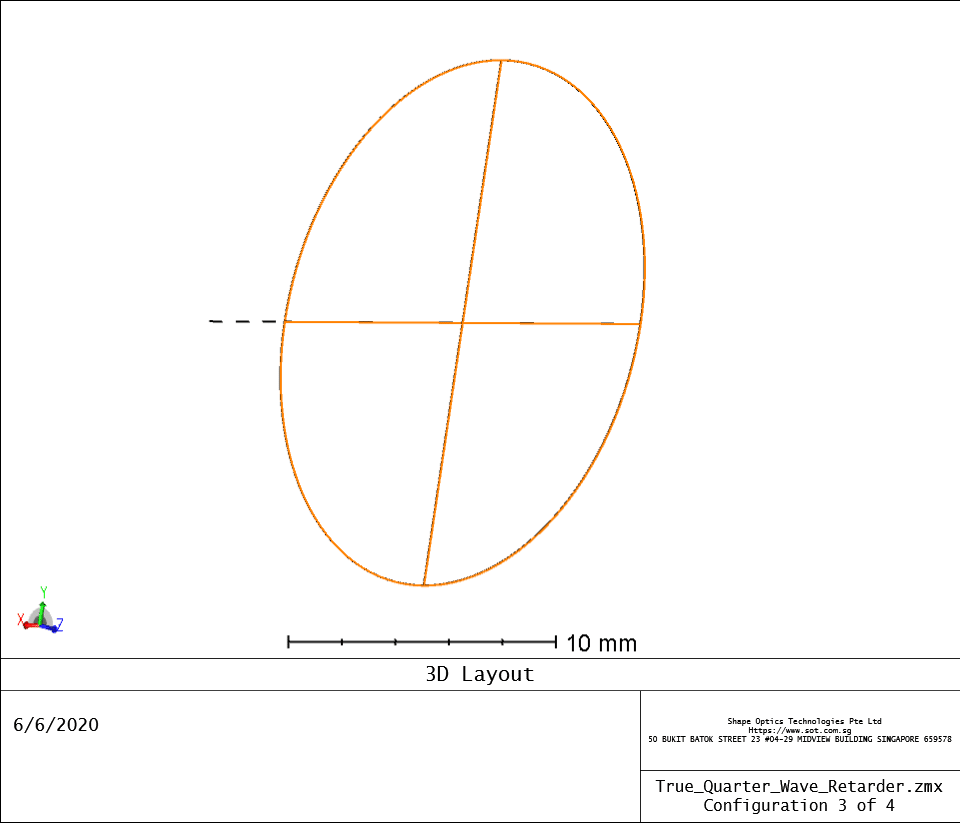
To build such a true zero-order waveplate in OpticStudio, the Lens Data Editor can be configured as shown below:

Modeling Zero-Order Waveplates in OpticStudio
In Zemax OpticStudio, waveplates can be modeled using birefringent materials and polarization ray tracing.
True Zero-Order Waveplate Model
- Single birefringent plate
- Very thin crystal thickness
- Exact retardance at design wavelength
Effective Zero-Order Waveplate Model
- Two birefringent plates
- Orthogonal crystal orientations
- Net retardance equals λ/4 or λ/2
In practice, effective zero-order models are preferred to match real manufactured components.
To build such a component in OpticStudio, the Lens Data Editor should be configured as shown below:


References