
Vignetting describes the reduction of image brightness toward the edge of the field of view relative to the image center. In optical systems, vignetting occurs when part of the light bundle is blocked or clipped as it propagates through the system.
Vignetting is most commonly caused by:
- Finite surface apertures
- Mechanical stops or housings
- Overfilling optical elements with fixed clear apertures
Vignetting may be:
- Intentional – used by designers to suppress aberrations or control stray light
- Unintentional – a side effect of compact designs or oversized input beams
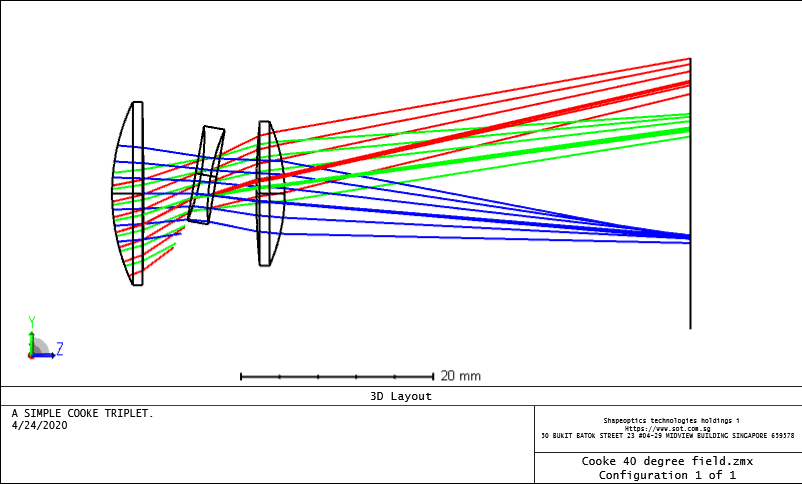
Vignetting in Optical Design
From an optical design perspective, vignetting directly affects:
- Relative illumination
- Image uniformity
- Radiometric accuracy
- Effective numerical aperture across the field
In imaging, vignetting often appears as edge darkening, while in laser or illumination systems it manifests as clipped beams or reduced throughput at off-axis field points.
Vignetting Factors: What Do They Mean?
Vignetting factors describe how the entrance pupil is seen by each field point in the presence of vignetting.
They define:
- Which portion of the entrance pupil is actually accessible to a given field
- How much of the input beam is transmitted without clipping
Instead of tracing rays that are later rejected by apertures, vignetting factors modify the launched ray bundle itself, ensuring that only valid rays are traced.
The “Set Vignetting” Tool in OpticStudio
In Zemax OpticStudio, the Set Vignetting tool automatically determines the appropriate vignetting factors for each field point.
What the Tool Does
- Analyzes aperture clipping throughout the system
- Computes vignetting limits for each field
- Assigns vignetting factors that describe the usable pupil region
These factors are then used during ray tracing and optimization.
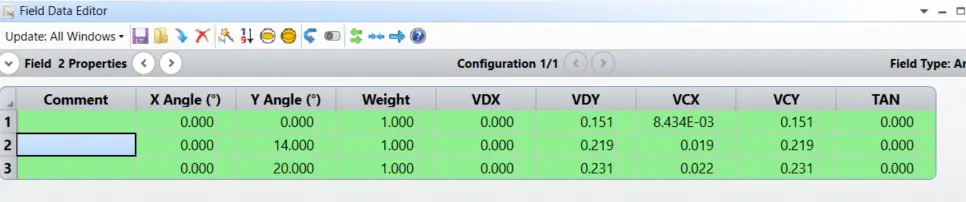
Why Vignetting Factors Are Important
1. Accurate Physical Modeling
Without vignetting factors:
- Rays may be traced that are physically blocked
- Relative illumination predictions may be misleading
With vignetting factors:
- Only physically valid rays are launched
- Throughput and illumination are modeled correctly
2. Faster and More Stable Optimization
During optimization, OpticStudio can choose between different pupil sampling methods.
When vignetting factors are defined:
- Gaussian Quadrature sampling becomes available
- Fewer rays are needed
- Merit function evaluation is faster and more stable
This is especially important for:
- Wide-field systems
- Strongly vignetted designs
- Designs under heavy optimization
3. Better Control of Intentional Vignetting
Designers sometimes intentionally vignette a system to:
- Reduce off-axis aberrations
- Improve image quality at the expense of illumination
Vignetting factors allow this trade-off to be controlled precisely and consistently across the field.
Practical Design Guidance
- Use Set Vignetting once apertures are reasonably defined
- Re-run vignetting analysis after major geometry changes
- Enable vignetting factors before final optimization
- Verify results using relative illumination plots
- Be cautious when interpreting edge performance without vignetting enabled
Summary
- Vignetting is a fundamental brightness-limiting effect in optical systems
- It arises from finite apertures and mechanical constraints
- Vignetting factors describe how each field point views the entrance pupil
- The Set Vignetting tool in OpticStudio automatically computes these factors
- Proper use improves accuracy, optimization speed, and stability
Understanding and controlling vignetting is essential for high-performance imaging, illumination, and radiometric systems.
References
- What Is Vignetting? – Photography Life https://photographylife.com/what-is-vignetting
- Zemax Knowledge Base – Vignetting Factors https://my.zemax.com/en-US/Knowledge-Base/kb-article/?ka=KA-01393
- https://www.zemax.com/