
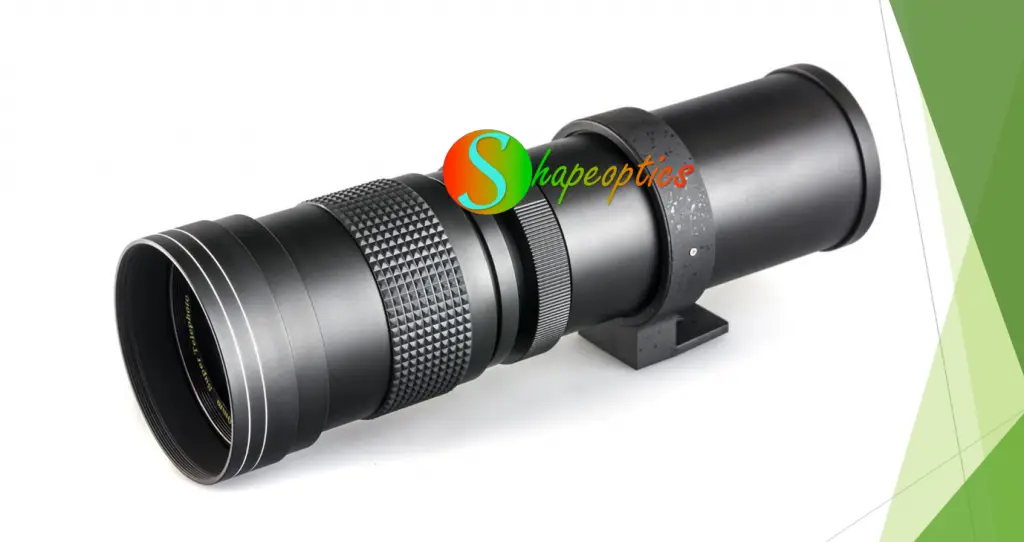
A telephoto lens provides long effective focal length while maintaining a shorter physical length than its focal length. This allows distant subjects to be magnified without requiring a physically long optical system—an essential advantage in SLR and DSLR camera design, surveillance optics, and long-range imaging systems.
Telephoto lenses are widely used when:
- Space and weight must be minimized
- Long focal length is required
- Back focal distance must accommodate a camera mirror or sensor package
Basic Telephoto Lens Structure
A classical telephoto lens consists of:
- A front positive group with focal length Fa
- A rear negative group with focal length Fb
- A separation distance T between the two groups
This configuration shortens the overall lens length while preserving long focal length.

Telephoto Ratio Definition
The telephoto ratio is defined as:
Telephoto Ratio = L/F
Where:
- L = overall physical length of the lens
- F = effective focal length
A telephoto ratio:
- < 1 → telephoto design
- Smaller values → more compact lens
This definition follows classical lens theory (Cooke, 1965).

Solving the above equations gives

Under the thin-lens assumption, the combined focal length of the two groups and their separation can be expressed analytically.
A key design result: The absolute value of the rear negative focal length (|Fb|) is maximized when T=L/2
This provides an important guideline for balancing:
- Compactness
- Aberration correction
- Mechanical feasibility
Example 1: f/2.8 Telephoto Lens for SLR Camera
The figure below (referenced design) shows an f/2.8 telephoto lens designed for a single-lens reflex (SLR) camera, with:
- Film diagonal: 1.703 in
- Compact overall length
- Adequate back focal distance for mirror clearance
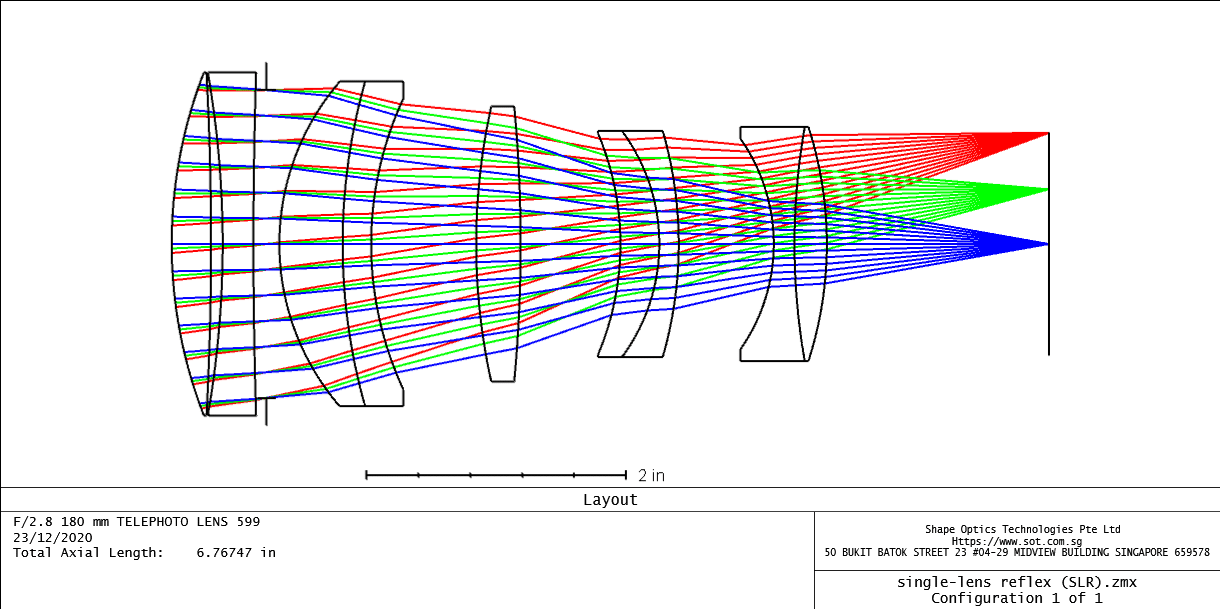
The full lens prescription is shown below:

This example illustrates how a telephoto configuration enables fast aperture performance without excessive lens length.
Example 2: 1000 mm f/11 Telephoto Lens Design
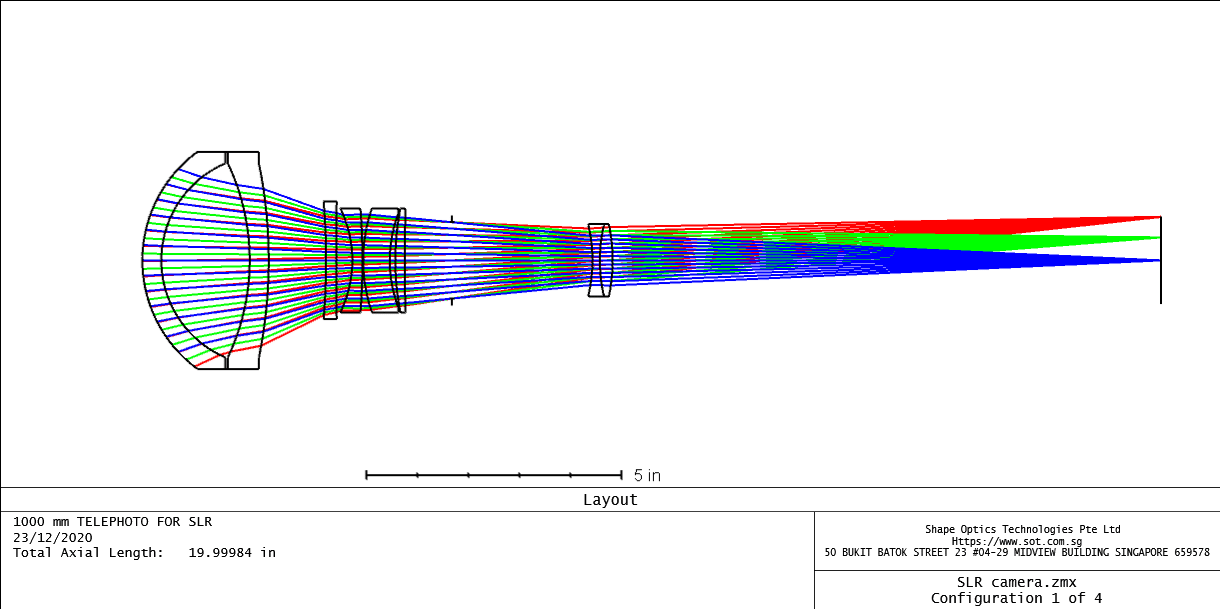
A second example demonstrates a 1000 mm f/11 telephoto lens, suitable for SLR cameras.
Key Parameters
- Image diameter: 1.704 in
- Overall length: 20.00 in
- Telephoto ratio: L/F=0.508
Mechanical and Optical Characteristics
- Front triplet includes a thick middle element, making the lens front-heavy
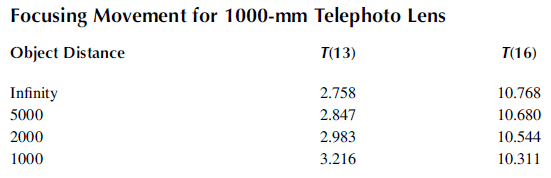
- Focusing is achieved by moving the rear cemented doublet
- Aperture diameter remains fixed during focusing
- Overall lens length is held constant, a common requirement in telephoto systems
The detailed focusing movement data is provided in the accompanying table and design file.
References
- Laikin, Milton. Lens Design. CRC Press, 2007.
- https://www.zemax.com/
- The design file used in this article is attached. Single-lens reflex (SLR) / SLR camera