
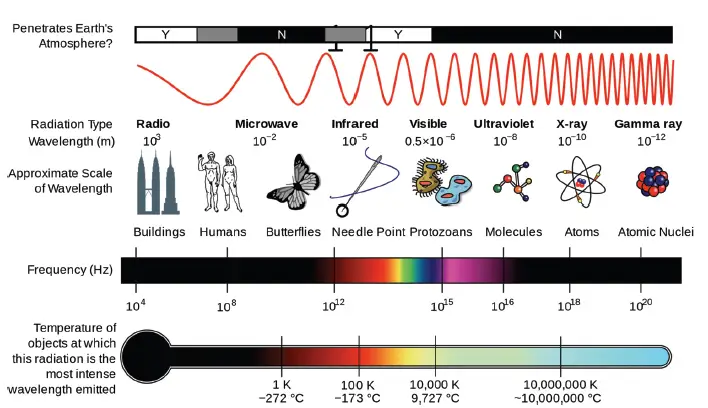
LiDAR (Light Detection and Ranging) is an active sensing technology that operates using electromagnetic (EM) waves in the optical and infrared spectrum. Unlike passive electro-optical (EO) sensors, LiDAR emits its own radiation and detects the returned signal, enabling reliable operation independent of ambient illumination.
Because LiDAR operates at much shorter wavelengths than microwave radar, it delivers significantly higher angular resolution, though it is more sensitive to atmospheric conditions such as fog, clouds, and rain.
Active vs Passive Optical Sensing
LiDAR (Active Sensor)
- Emits and receives its own optical signal
- Operates effectively day and night, typically in the near-infrared (NIR) or short-wave infrared (SWIR)
- Range is measured directly by timing the emitted light
- Illumination, timing, and waveform are fully controlled
Passive EO Sensors
- Rely on external radiation (sunlight or thermal emission)
- Nighttime operation in the infrared is limited by insufficient available photons
- Performance is constrained by blackbody radiation, which dominates noise
Because LiDAR does not depend on background illumination, it avoids many limitations faced by passive EO systems, especially in low-light or nighttime conditions.
LiDAR Wavelengths Compared to Radar
LiDAR operates at optical and infrared wavelengths, which are orders of magnitude shorter than those used in radar systems. On a logarithmic EM spectrum scale, these differences are substantial.
Example Comparison
X-band microwave radar
Frequency: ~10 GHz
Wavelength: ~3 cm
Eye-safe LiDAR
Frequency: ~200 THz
Wavelength: ~1.5 µm
This represents a wavelength difference of roughly 20,000×, resulting in:
- Much higher carrier frequency
- Dramatically improved diffraction-limited angular resolution
While X-rays and gamma rays operate at even shorter wavelengths, LiDAR occupies a practical region of the spectrum that balances resolution, safety, and propagation.
The relationship between wavelength and frequency is given by:
c=λν
where:
- c is the speed of light
- λ is wavelength
- v is frequency
Radar engineers often work in frequency, while optical engineers typically specify wavelength—both describe the same physics.
Atmospheric Propagation and Environmental Limits
LiDAR performance is strongly influenced by atmospheric particle size relative to wavelength:
- Fog particles: ~1–100 µm
- Raindrops: ~0.5–5 mm
Propagation Comparison
- Microwave radar (3–30 cm): Largely unaffected by fog and light rain
- Millimeter-wave radar (95 GHz, ~3.16 mm): Penetrates fog but is partially attenuated by rain
- LiDAR (1.5 µm): Strongly scattered by fog, clouds, and rain
Longer-wavelength LiDAR variants (e.g., ~10 µm) still struggle in dense clouds or fog, as atmospheric particles are often comparable to or larger than the wavelength, causing significant scattering and attenuation.
Imaging Capabilities: 2D, 3D, and Beyond
LiDAR is a powerful imaging sensor, capable of extracting multiple observables:
2D Imaging
- Range-resolved images similar to EO imagery
- Independent of ambient lighting
3D Imaging
- Measures range per pixel
- Uses voxels (3D pixels) to encode geometry and intensity
- Supports accurate scene reconstruction
Velocity and Vibration
- Coherent LiDAR measures phase and frequency
- Doppler shift enables velocity estimation
- Laser vibrometry detects vibration modes
Speckle Effects
- Coherent interference creates bright and dark patterns
- Can be averaged out or exploited for surface characterization
Observable Features Detected by LiDAR
LiDAR can detect a wide range of physical observables, commonly grouped into five categories:
- Geometry: Shape, size, and intensity distribution in 1D, 2D, or 3D
- Surface Character: Roughness, scattering behavior, reflectivity, polarization
- Plant Noise: Vibrations and cyclical motion from machinery or engines
- Effluents: Exhaust gases, plumes, and emissions
- Gross Motion: Translation, rotation, articulation, or structural movement
Because LiDAR operates at wavelengths close to human vision, it provides intuitive, visually interpretable imagery, unlike radar, which often produces specular highlights and ambiguous bright spots.
Advantages Over Passive EO and Radar
- Active illumination enables night and low-light imaging
- Shorter wavelengths deliver superior angular resolution
- Range is measured directly in every pixel
- Less ambiguity than radar for object identification
- Supports grayscale, color, polarization, and velocity data
Advanced techniques such as synthetic-aperture LiDAR and multiple-input, multiple-output (MIMO) architectures further enhance resolution by synthesizing larger effective apertures from multiple measurements.
Summary
LiDAR occupies a unique position in the electromagnetic spectrum, combining the high resolution of optical wavelengths with the self-illumination advantage of active sensing. While more sensitive to atmospheric conditions than radar, LiDAR delivers unmatched spatial detail, accurate ranging, and rich multidimensional data.
Its ability to generate high-fidelity 2D and 3D images, measure velocity and vibration, and operate independently of ambient light makes LiDAR an indispensable sensing technology across military, industrial, environmental, and commercial applications.