
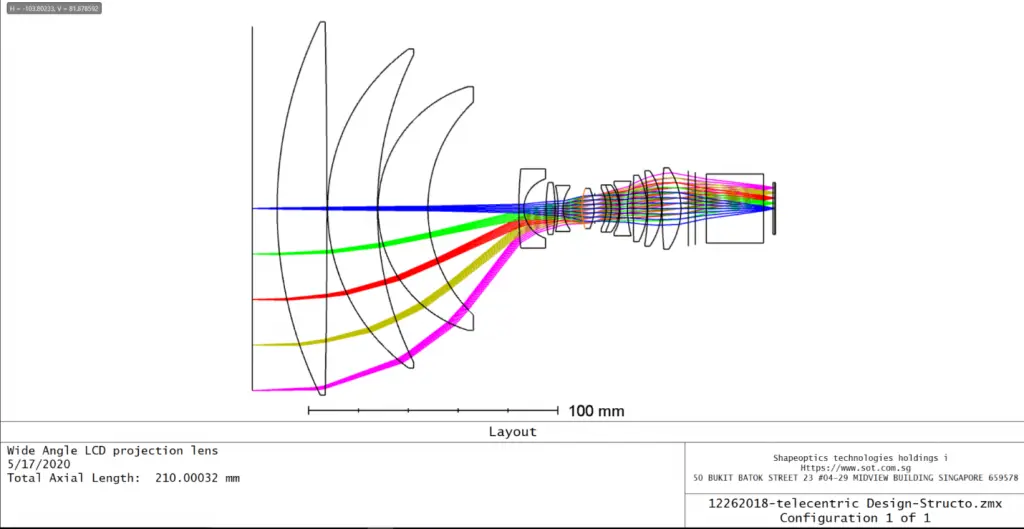
Image-space telecentric lenses are optical systems in which the chief rays are parallel to the optical axis in image space. This means the exit pupil is located at infinity.
Such lenses are especially valuable in applications where image irradiance and magnification must remain stable, including:
- Radiometric and photometric measurements
- Machine vision and metrology
- Fluorescence and scientific imaging
- Imaging onto flat sensors with strict angular acceptance
In this article, we discuss three practical methods for enforcing image-space telecentricity in Code-V OpticStudio.

What Does Image-Space Telecentric Mean?
An optical system is telecentric in image space when:
- The chief ray angle at the image plane is 0°
- Chief rays strike the detector normal to the image plane
- The exit pupil is effectively at infinity
Key benefits:
- Constant magnification despite small image-plane shifts
- Uniform irradiance across the sensor
- Reduced cosine falloff
- Improved measurement accuracy
Three Ways to Enforce Image-Space Telecentricity in OpticStudio
OpticStudio provides three different approaches to constrain the exit pupil to infinity. Each method is useful in different design stages.
1. Chief Ray Angle (RANG) Curvature Solve
Concept
Image-space telecentricity requires the chief ray angle at the image plane to be zero. This can be enforced by applying a Chief Ray Angle solve on a surface curvature.
How It Works
- Apply a Chief Ray Angle = 0° solve
- OpticStudio adjusts the radius of curvature of the selected surface
- The chief ray exits the system parallel to the optical axis
When to Use
- Early design stages
- Simple systems
- Educational or conceptual designs
Limitations
- Only one surface is adjusted
- Limited flexibility for complex multi-element systems
2. EXPP Operand (Exit Pupil Position)
Concept
The EXPP operand directly controls the exit pupil position.
- Setting EXPP = Infinity forces the exit pupil to infinity
- This guarantees image-space telecentricity explicitly
How It Works
- Add EXPP to the Merit Function Editor (MFE)
- Set the target value to infinity
- Assign appropriate weighting
When to Use
- Robust optimization workflows
- Multi-element or complex systems
- When pupil location is a strict requirement
Advantages
- Explicit physical control of exit pupil
- Stable during optimization
- Works well with other performance constraints
3. RANG Operand (Chief Ray Angle at Image Plane)
Concept
The RANG operand directly minimizes the chief ray angle at a specified surface, usually the image surface.
Telecentricity condition: RANG = 0°
How It Works
- Insert RANG in the Merit Function
- Specify the image surface
- Optimize until chief ray angle is driven to zero
When to Use
- Optimization-driven designs
- Fine tuning of telecentric behavior
- When you want direct control of angular behavior
Advantages
- Intuitive physical meaning
- Works well in combination with contrast or MTF optimization
Comparison of the Three Methods
| Method | Controls | Best Use Case |
|---|---|---|
| Chief Ray Angle Solve | Surface curvature | Simple / early designs |
| EXPP Operand | Exit pupil position | Robust, production designs |
| RANG Operand | Chief ray angle | Optimization and fine tuning |
Best practice:
- Use EXPP or RANG for final designs
- Use Chief Ray Angle solve for quick setup or teaching
Practical Design Tips
- Telecentricity is most sensitive to image-side optics
- Combine telecentric constraints with MTF or spot size goals
- Avoid over-constraining early in optimization
- Always verify with ray fan and pupil analysis
- Check irradiance uniformity on the detector
Summary
Image-space telecentric lenses are essential for high-accuracy imaging and measurement systems.
In OpticStudio, telecentricity can be achieved in three reliable ways:
- Chief Ray Angle curvature solve
- EXPP operand (exit pupil control)
- RANG operand (chief ray angle control)
Choosing the right method depends on design complexity, optimization strategy, and performance requirements.