
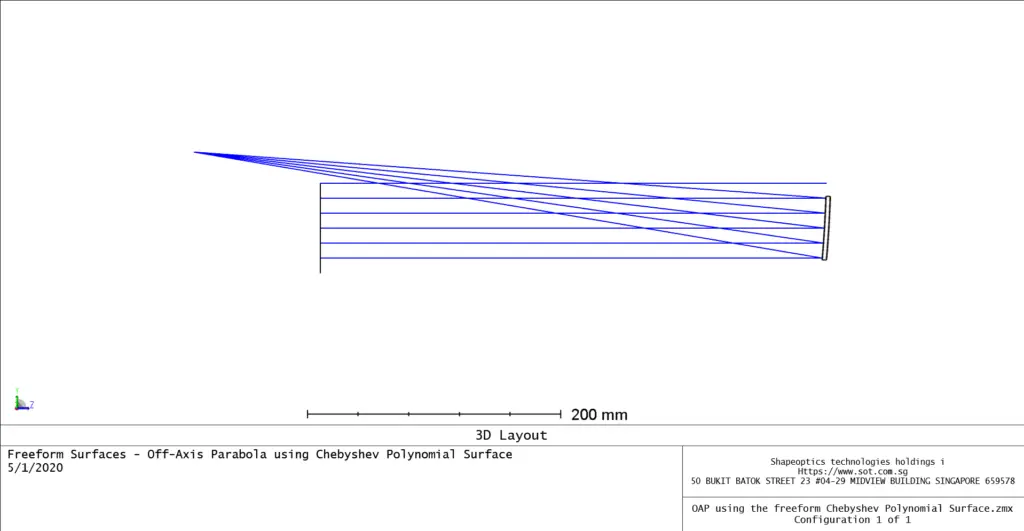
Zemax OpticStudio provides a comprehensive set of tools for freeform optical design, supporting both Sequential and Non-Sequential ray tracing modes.
Freeform optics enable designers to:
- Correct aberrations more efficiently
- Reduce element count
- Enable compact or off-axis systems
- Achieve performance not possible with rotationally symmetric optics
In this article, we focus specifically on freeform surface types supported in Sequential Mode, and provide a practical overview of more than 20 freeform surfaces available in OpticStudio.
Finding Freeform Surfaces in OpticStudio
To quickly locate freeform surface types:
- Open the Lens Data Editor (LDE)
- Click on the Surface Type cell
- Use the surface filtering options
Available filters include:
Freeform → displays all freeform surface types
Conventional → shows common surfaces such as:
Even Asphere
Q-Type Asphere
This filtering capability makes it easy to select the appropriate surface without manually searching through the full list.

Categories of Freeform Surfaces in Sequential Mode
The freeform surfaces in OpticStudio can be grouped into three main categories:
- Polynomial Freeform Surfaces
- Diffractive Freeform Surfaces
- Freeform Fits to Control Points
Each category serves different optical design needs.
1. Polynomial Freeform Surfaces
These surfaces describe sag using analytical polynomial expressions, making them well suited for optimization-driven designs.
Available Polynomial Freeform Surfaces
- Biconic Zernike
- Chebyshev Polynomial
- Cylinder Fresnel
- Extended Fresnel
- Generalized Fresnel
- Odd Asphere
- Extended Odd Asphere
- Polynomial
- Extended Polynomial
- Superconic
- Zernike Annular Standard Sag
- Zernike Fringe Sag
- Zernike Standard Sag
Typical Applications
- Aberration correction in imaging systems
- Off-axis and asymmetric optics
- Compact camera lenses
- Head-up displays (HUDs)
2. Diffractive Freeform Surfaces
These surfaces combine freeform geometry with diffractive behavior, allowing advanced wavefront control.
Available Diffractive Freeform Surfaces
- Elliptical Grating 1
- Elliptical Grating 2
- Toroidal Grating
- Extended Toroidal Grating
Typical Applications
- Spectrometers
- Beam shaping and splitting
- Wavelength-selective systems
- Compact dispersive optics
3. Freeform Fits to Control Points
These surfaces are defined by discrete control points, rather than explicit polynomial equations. They are especially useful when importing or reverse-engineering measured or CAD-based surfaces.
Available Control-Point Freeform Surfaces
- Cubic Spline
- Extended Cubic Spline
- Grid Gradient
- Grid Sag
- Radial NURBS
- Toroidal NURBS
Typical Applications
- Reverse engineering measured optics
- CAD-driven optical design
- Illumination optics
- Automotive and architectural lighting
Choosing the Right Freeform Surface
General guidance:
- Use polynomial freeforms for optimization-driven imaging systems
- Use Zernike-based surfaces for wavefront-centric designs
- Use diffractive freeforms for spectral or beam-control functions
- Use NURBS or grid-based surfaces when geometry comes from CAD or measurement
Often, multiple freeform surface types are evaluated during early design stages to determine which representation provides the best performance-to-complexity balance.
Key Takeaways
- OpticStudio supports 20+ freeform surfaces in Sequential Mode
- Surface filtering simplifies freeform selection
- Polynomial, diffractive, and control-point freeforms serve different roles
- Freeform optics enable compact, high-performance systems
- Choosing the right surface type improves optimization efficiency
Freeform optics are no longer niche—they are a core tool in modern optical design.
References
- Tricard, M., & Bajuk, D. Practical Examples of FreeForm Optics, OSA Technical Digest, Renewable Energy and the Environment (2013), Paper FT3B.2
- https://www.zemax.com/