
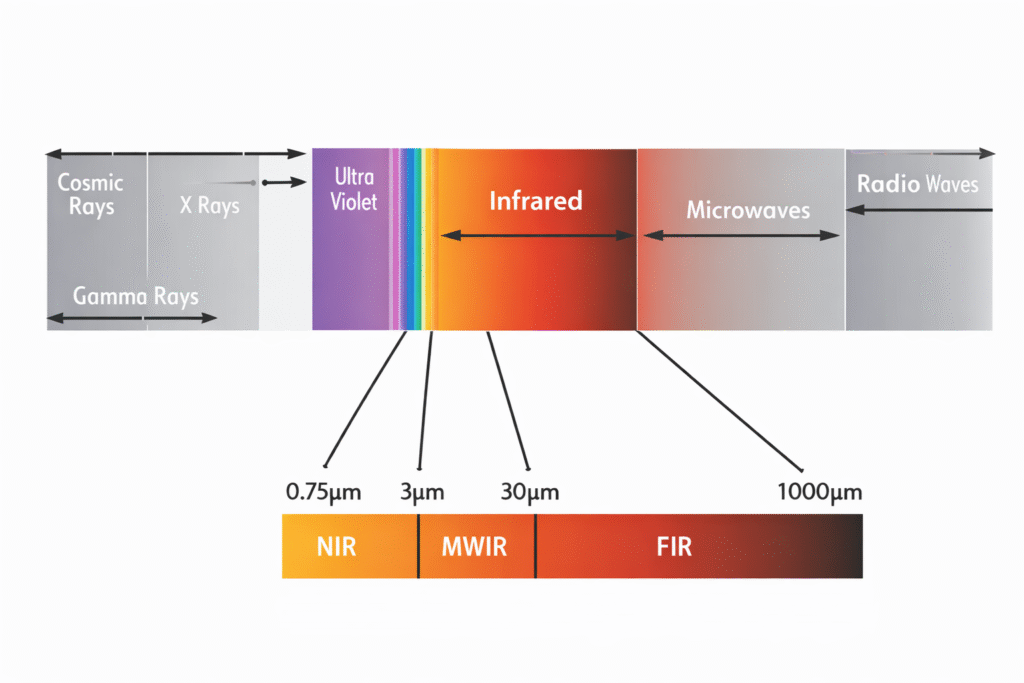
Infrared (IR) is a form of electromagnetic radiation, just like visible light, radio waves, X-rays, and microwaves. What makes infrared different is its wavelength and energy level.
Infrared as an Electromagnetic Wave
Infrared is part of the electromagnetic spectrum.
Electromagnetic radiation consists of oscillating electric and magnetic fields traveling through space at the speed of light.
The full spectrum (from shortest wavelength to longest): Gamma → X-ray → UV → Visible → Infrared → Microwave → Radio
Visible light occupies only a tiny portion of this spectrum. Infrared is invisible light energy that exists just beyond the red end of the visible spectrum. Although we cannot see it, we experience it every day — as heat.
Wavelength and Energy
Infrared radiation has:
- Longer wavelength than visible light
- Lower energy than visible light
Visible light wavelength: 0.4 – 0.7 µm
Infrared wavelength: 0.7 µm – 1000 µm (1 millimeter)
As wavelength increases:
- Energy decreases
- Frequency decreases
This lower energy is why infrared is associated with heat rather than brightness.
Infrared Is Thermal Radiation
Every object above absolute zero (-273.15°C) emits electromagnetic radiation. That includes humans, animals, buildings, vehicles, and machines.
This emission is called thermal radiation.
The temperature of an object determines:
- How much radiation it emits
- At what wavelength it emits most strongly
For objects near room temperature (~300K), the peak emission falls in the 8–12 µm region, which is in the long-wave infrared (LWIR).
This is why thermal imaging systems often operate in that band.
This behavior follows a physical law called Planck’s Law.
Why We Cannot See Infrared
The human eye detects wavelengths between: 0.4 – 0.7 µm
Infrared starts at 0.7 µm and extends much further.
Our retinal photoreceptors are not sensitive to longer wavelengths, so infrared is invisible to us — even though it is physically present.
However, our skin can detect infrared as warmth.
When you feel heat from sunlight or a heater, you are sensing infrared radiation.
Infrared Regions Explained
Infrared is commonly divided into regions:
| Region | Wavelength | Common Use |
|---|---|---|
| NIR (Near IR) | 0.7–1.4 µm | Fiber optics, night vision |
| SWIR (Shortwave IR) | 1–3 µm | Industrial inspection |
| MWIR (Midwave IR) | 3–5 µm | High-sensitivity thermal imaging |
| LWIR (Longwave IR) | 8–12 µm | Most thermal cameras |
Two important physical mechanisms dominate:
- Reflected infrared (NIR/SWIR)
- Emitted thermal infrared (MWIR/LWIR)
This distinction is critical.
Reflected vs Emitted Infrared
Reflected Infrared (Shorter Wavelengths)
In NIR and SWIR, objects are illuminated by an external source (sunlight or IR LED), and the radiation is reflected.
This behaves more like visible light imaging.
Emitted Infrared (Thermal Region)
In MWIR and LWIR, objects emit their own radiation. No external light source is required.
This is true thermal detection.
Infrared and Blackbody Radiation
A “blackbody” is an ideal object that absorbs and emits radiation perfectly.
The wavelength of maximum emission follows:
Wien’s Displacement Law: λmax ≈ 2898 / T (µm·K)
At room temperature (~300K): λmax ≈ 9.6 µm
That sits directly in the LWIR band.
This is why LWIR is ideal for detecting people, buildings, and vehicles.
Interaction With Matter
When infrared radiation hits matter, three things happen:
- Transmission
- Reflection
- Absorption
Which behavior dominates depends on:
- Atomic structure
- Bandgap energy
- Molecular vibrations
Infrared often interacts strongly with molecular vibration modes, especially in organic materials and gases.
This is why IR spectroscopy is used for chemical analysis.
Why Infrared Is So Powerful
Infrared detection works:
- In total darkness
- Through smoke
- Through light fog
- Without illumination
Because it detects energy that objects emit naturally. It does not depend on reflected visible light.
Key Takeaway
Infrared is:
- Invisible electromagnetic radiation
- Lower energy than visible light
- Emitted naturally by all objects
- Strongly tied to temperature
- Governed by fundamental physics laws
Only after understanding these principles does it make sense to discuss:
- Thermal cameras
- Infrared detectors
- Optical materials like germanium or silicon
Because those technologies are simply tools designed to capture and manipulate this radiation.