
Understanding Lasers: Types and Key Characteristics
LASER stands for Light Amplification by Stimulated Emission of Radiation. It is a device that generates highly directional and coherent light by amplifying light through the process of stimulated emission. Unlike conventional light sources, lasers have distinct advantages, making them invaluable in various fields like communication, medicine, and industrial applications.
Key Characteristics of Laser Light
Lasers exhibit four key properties that distinguish them from ordinary light sources:
1. Coherence
Laser light is coherent, meaning all photons emitted are in phase, which results in a narrow, focused beam. This is in contrast to ordinary light sources, where photons are emitted in random phases.
2. Directionality
The laser beam is highly directional, meaning the light stays tightly focused, even over long distances. This contrasts with ordinary light, which spreads out in all directions.
3. Monochromaticity
Laser light is monochromatic, meaning it consists of a single wavelength or color. This is beneficial for applications requiring pure light, such as in spectrometry and optical communication.
4. High Intensity
Lasers have high intensity due to the concentration of energy in a narrow beam. This high energy concentration makes lasers ideal for cutting, welding, and medical treatments.
Types of Lasers
Lasers can be categorized based on the type of medium used to produce the laser light. There are four main types:
1. Solid-State Lasers
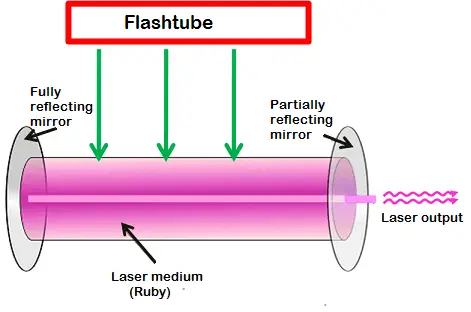
Solid-state lasers use a solid medium (glass or crystal) that is doped with impurities (called dopants) to create the laser effect. The dopants, such as rare earth elements (e.g., neodymium), allow the solid material to emit light when energy is applied.
- Common examples: Neodymium-doped YAG (Nd:YAG) laser, Ruby laser
- Application areas: Material processing, laser pointers, medical equipment
Pump Source: Light energy (e.g., flash lamps, laser diodes) is used to excite the doped medium.
Note: Unlike semiconductor lasers, solid-state lasers typically rely on light energy for excitation, while semiconductor lasers rely on electrical energy.
2. Gas Lasers
Gas lasers use a gaseous medium (a mixture of gases like neon, argon, or CO₂) to produce laser light when an electric current passes through the gas.
- Common examples: Helium-Neon (HeNe) laser, Carbon Dioxide (CO₂) laser
- Application areas: High-precision cutting, medical diagnostics, holography
Working Principle: Electrical energy excites the gas atoms, causing them to emit light when they return to their ground state.
Characteristics: These lasers are typically known for their long coherence lengths and ability to generate continuous beams. They operate in a variety of wavelengths, depending on the gas mixture.

3. Liquid Lasers
Liquid lasers use organic dye solutions as the laser medium. These lasers are tunable across a wide spectrum, which makes them ideal for applications requiring a specific wavelength.
- Common example: Dye laser
- Application areas: Spectroscopy, tunable lasers for research
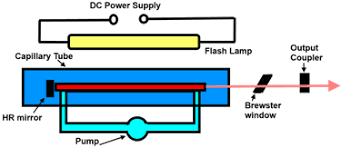
Working Principle: The dye solution is excited by light energy (often from flash lamps), causing it to emit light in the form of laser pulses.
Characteristics: These lasers offer wavelength tunability and can generate a variety of wavelengths across the UV and IR regions. However, they are not as widely used as solid-state and gas lasers due to their complexity and maintenance needs.
4. Semiconductor Lasers
Semiconductor lasers, also known as laser diodes, are compact and operate using a p-n junction of semiconductor materials (e.g., gallium arsenide) to create laser light when electrical current passes through the junction.
- Common example: Laser diodes (e.g., CD/DVD players, fiber-optic communication)
- Application areas: Telecommunications, barcode scanners, fiber optics
Working Principle: Electrical current excites the semiconductor material, creating photon emission. The laser light is emitted in a narrow beam.
Characteristics: These lasers are highly efficient and can be made small and cheap, making them ideal for consumer electronics and telecommunications.

Comparing Laser Types
| Feature | Solid-State Laser | Gas Laser | Liquid Laser | Semiconductor Laser |
|---|---|---|---|---|
| Medium | Solid (Glass/Crystal) | Gas (e.g., HeNe, CO₂) | Liquid (Organic Dye) | Semiconductor (P-N Junction) |
| Excitation Source | Light (flash lamps) | Electrical (current) | Light (flash lamps) | Electrical (current) |
| Beam Quality | High | High | Moderate | High |
| Wavelength Range | Fixed | Fixed (depends on gas) | Tunable | Fixed (wavelengths available) |
| Applications | Materials, medical, industrial | Medical, holography, high-precision cutting | Spectroscopy, research | Telecom, consumer electronics, fiber-optics |
| Cost | Higher | Higher | High | Low |
Applications of Lasers
Lasers are used in a broad range of applications, including but not limited to:
- Telecommunications: Semiconductor lasers are widely used in fiber-optic communication.
- Medical: Lasers are used for laser surgery, eye treatment (e.g., LASIK), and diagnostic tools.
- Industrial: Gas and solid-state lasers are crucial in cutting, welding, and engraving materials.
- Military & Defense: Lasers are used in rangefinding, targeting, and weapon systems.
- Entertainment: Lasers are commonly used in light shows, projectors, and displays.
Summary
A laser is a device that generates highly focused, coherent light through stimulated emission. The key characteristics—coherence, monochromaticity, directionality, and high intensity—make lasers essential in numerous high-tech applications. The different types of lasers (solid-state, gas, liquid, and semiconductor) each have distinct advantages, making them suited for various needs across industries like telecommunications, medical, industrial, and entertainment.