
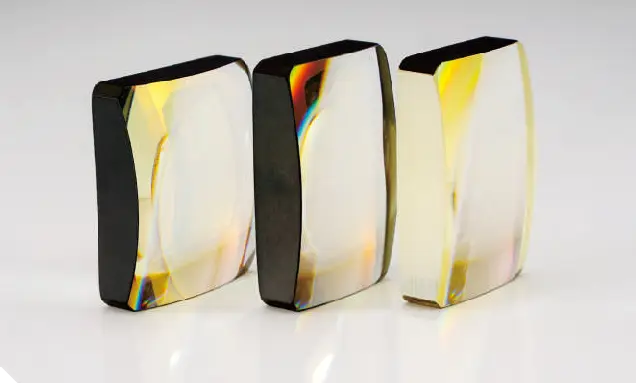
At Shape Optics Technologies Pte Ltd (SOT), we offer a comprehensive range of optical lens materials designed to meet diverse performance, wavelength, environmental, and cost requirements. Selecting the right substrate is critical to achieving high transmission, durability, and overall optical system efficiency.
The table below provides an overview of the most commonly used materials in precision optical components, along with their key characteristics and applications.
Common Optical Lens Materials Overview
| Material | Transmission Range | Key Features & Applications |
|---|---|---|
| N-BK7 | 350 nm – 2.0 µm | A widely used RoHS-compliant borosilicate crown glass. Ideal for visible and near-IR optics due to excellent clarity, good mechanical strength, and cost efficiency. |
| UV Fused Silica (UVFS) | 185 nm – 2.1 µm | High-performance material with excellent UV transmission, very low fluorescence, and superior homogeneity. Low thermal expansion makes it ideal for UV, VIS, and NIR spectroscopy and laser systems. |
| N-SF11 | 420 nm – 2.3 µm | Dense flint glass with high refractive index and low Abbe number. Suitable for precision lenses and prisms requiring strong dispersion and chromatic correction. |
| Calcium Fluoride (CaF₂) | 180 nm – 8.0 µm | Durable crystal with low refractive index and low fluorescence. Broad UV–IR transmission makes it ideal for high-power laser optics and excimer laser systems. |
| Barium Fluoride (BaF₂) | 200 nm – 11.0 µm | Similar to CaF₂ with improved resistance to radiation damage. Commonly used in space optics and high-energy physics. Note: Limited resistance to prolonged moisture exposure. |
| Silicon (Si) | 1.2 – 8.0 µm | Lightweight with excellent thermal conductivity. Commonly used in mid-IR optics such as thermal imaging and IR sensors. Not suitable for CO₂ laser optics due to absorption near 9 µm. |
| Zinc Selenide (ZnSe) | 600 nm – 16.0 µm | Premium infrared material with broad transmission and low absorption. Widely used for CO₂ laser optics (10.6 µm) and compatible with HeNe alignment lasers. |
| Germanium (Ge) | 2.0 – 16.0 µm | Leading material for mid- and long-wave IR optics. Chemically inert and ideal for thermal imaging, night vision, and spectroscopy. Transmission is temperature-dependent and should be considered in design. |
| Magnesium Fluoride (MgF₂) | 200 nm – 6.0 µm | Extremely rugged and environmentally stable. Commonly used in UV and visible optics, microscopy, and industrial vision systems. |
| PTFE (Polytetrafluoroethylene) | 30 µm – 1.0 mm | Specialty optical polymer with refractive index ~1.4 and low dielectric constant. Ideal for terahertz (THz) applications from 300 GHz to 10 THz. |
Why Optical Material Choice Matters
Choosing the correct optical lens material is essential to:
- Maximize transmission within the operating wavelength
- Minimize absorption and reflection losses
- Ensure mechanical and environmental durability
- Extend component lifespan and system reliability
Whether using UV-grade fused silica for spectroscopy, germanium lenses for thermal imaging, or ZnSe substrates for CO₂ laser processing, material properties directly influence optical performance and long-term stability.
Material Selection Support from Shape Optics
Shape Optics Technologies Pte Ltd (SOT) provides tailored material recommendations based on your:
- Operating wavelength range
- Environmental and thermal conditions
- Mechanical constraints
- Optical design requirements
Our engineering team supports both standard and custom optical components, ensuring optimal material selection for your application.
Contact Shape Optics to discuss your optical material and lens design requirements.