
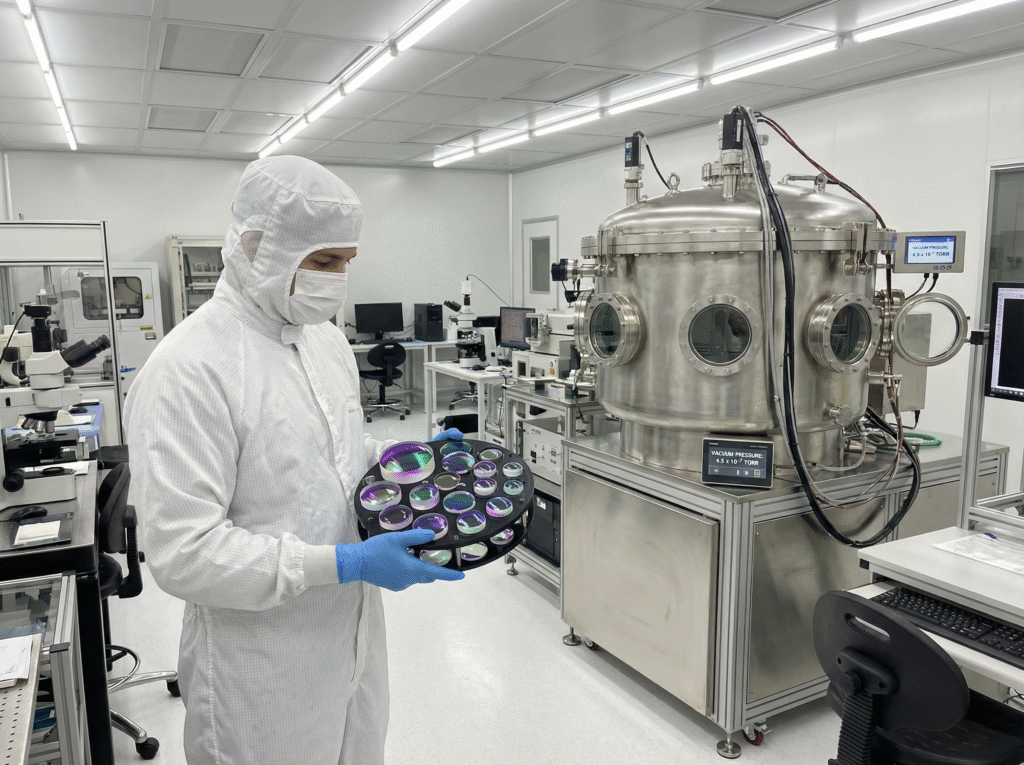
Optical coatings play a critical role in determining how an optical component performs in real-world applications. Whether you’re working with infrared windows, imaging lenses, or laser optics, choosing the right coating can significantly impact transmission, durability, and overall system reliability.
Below is a practical overview of common optical coatings such as AR, BBAR, DLC, and HR along with their features, specifications, and applications.
Understanding Common Optical Coatings
1. AR Coating (Anti-Reflective Coating)
AR coating is designed to reduce surface reflections and increase light transmission at a specific wavelength or narrow wavelength range.
Key Features
- Reduces surface reflection (typically <0.5% per surface at design wavelength)
- Increases transmission efficiency
- Optimized for a single wavelength or narrow band
- Available for VIS, NIR, MWIR, LWIR ranges
Typical Specifications
- Reflection: <0.5% @ design wavelength
- Wavelength range: Custom (e.g., 1064 nm, 3–5 µm, 8–12 µm)
- Substrates: Ge, Si, ZnSe, ZnS, CaF₂, Sapphire
Applications
- Laser optics
- Infrared imaging systems
- Scientific instruments
- Optical sensors
2. BBAR Coating (Broadband Anti-Reflective Coating)
BBAR coating reduces reflections over a wide spectral range rather than a single wavelength.
Key Features
- Low reflectance across broad wavelength range
- Improves transmission efficiency over wide band
- Multi-layer thin-film design
- Ideal for multi-spectral systems
Typical Specifications
Reflection: <1% average over specified band
Example ranges:
400–700 nm (VIS)
900–1700 nm (NIR)
3–5 µm (MWIR)
8–12 µm (LWIR)
Applications
- Multi-spectral imaging
- Thermal cameras
- Optical measurement systems
- Military & defense optics
3. DLC Coating (Diamond-Like Carbon Coating)
DLC is a hard, protective coating primarily used on infrared optics (especially germanium) to enhance durability and environmental resistance.
Key Features
- Extremely high hardness
- Scratch-resistant
- Water-repellent (hydrophobic)
- Improves environmental durability
- Suitable for harsh conditions
Typical Specifications
- High surface hardness (close to diamond-like properties)
- Transmission optimized for MWIR/LWIR
- Often combined with AR coating
- Good adhesion to Ge substrates
Applications
- Military infrared windows
- Outdoor surveillance systems
- Marine environments
- Desert or high-humidity conditions
4. HR Coating (High Reflective Coating)
HR coating is designed to maximize reflectivity at specific wavelengths.
Key Features
- Very high reflectance (typically >99%)
- Designed for specific wavelength
- Used in mirrors and laser cavities
Applications
- Laser resonators
- Optical mirrors
- Beam steering systems
Optical Coating Comparison Table
| Coating Type | Main Function | Reflection / Transmission | Spectral Range | Durability | Typical Applications |
|---|---|---|---|---|---|
| AR | Reduce reflection at single wavelength | R <0.5% @ design λ | Narrow band | Moderate | Laser optics, IR lenses |
| BBAR | Reduce reflection over wide band | R <1% avg over band | Broad band | Moderate | Thermal imaging, multi-spectral systems |
| DLC | Surface protection + IR transmission | High transmission in MWIR/LWIR | IR range | Very High | Germanium windows, harsh environments |
| HR | Maximize reflection | R >99% @ design λ | Narrow band | Moderate | Laser mirrors, cavity optics |
How to Choose the Right Coating?
- Need maximum transmission at one wavelength → AR coating
- Need low reflection across wide spectrum → BBAR coating
- Working in harsh environment (sand, salt, humidity) → DLC coating
- Need strong reflection (mirror application) → HR coating
Summary
The right coating ensures your optical component performs reliably in its intended environment. While AR and BBAR improve transmission efficiency, DLC enhances durability—especially critical for infrared materials like germanium.
Selecting the correct coating is not just about optical performance—it’s about matching environmental, mechanical, and system-level requirements.
If you’re unsure which coating best suits your application, feel free to contact us your wavelength range, substrate material, and working environment.