
Understanding common light bulb shapes, sizes, and styles is essential whether you’re upgrading from traditional incandescent bulbs to energy-efficient LEDs or designing lighting for new construction. Every light bulb is identified by a letter code and a number, collectively known as light bulb codes, which describe the bulb’s shape and diameter.
This guide focuses on PAR, BR, and MR bulbs, explaining their differences, sizing, beam angles, and best-use applications.
What do PAR, BR and MR Mean?
PAR – Parabolic Aluminized Reflector
PAR bulbs use a parabolic reflector to create a focused, directional beam.
- Typical beam angle: ≤ 45°
- Best for spotlighting and accent lighting
BR – Bulged Reflector
BR bulbs have a rounded (bulged) reflector, producing a wide flood beam.
- Typical beam angle: ≥ 100°
- Ideal for general-area illumination
MR – Multi-Faceted Reflector
MR bulbs feature faceted reflectors for very tight beam control.
- Narrowest beam angles
- Commonly used for precision spotlights
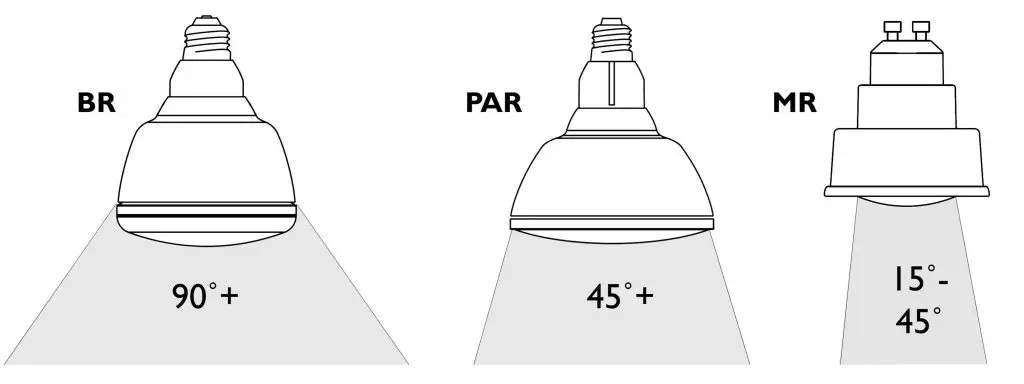
The primary difference between PAR, BR, and MR bulbs is the beam angle:
- MR → very narrow beam (spotlight)
- PAR → medium to narrow beam (accent/flood)
- BR → wide beam (general floodlight)
Internally, their reflector designs differ, but from a practical standpoint, beam spread is what matters most. See the figure below:

Understanding Bulb Sizes (The Number Code)
The number following PAR or BR indicates the diameter of the bulb in eighths of an inch.
Examples:
- BR30 → 30 ÷ 8 = 3.75 inches
- PAR38 → 38 ÷ 8 = 4.75 inches
This sizing system makes it easy to choose bulbs that fit existing fixtures.
PAR Bulb Comparison Chart
| PAR38 | PAR30 | PAR20 | PAR16 | |
| Image |  |  |  |  |
| Size |  |  |  |  |
| Brightness | 1200 – 1400 lm | 800 – 1100 lm | 500 – 700 lm | 300 – 400 lm |
| Watts | Incandescent – 75W CFL – 35W LED – 15W | Incandescent – 65W CFL – 22W LED – 9W | Incandescent – 40W CFL – 15W LED – 7W | Incandescent -35W CFL – 8W LED – 4W |
BR Bulb Comparison Chart
| BR40 | BR30 | BR20 | |
| Image |  |  |  |
| Size |  |  |  |
| Brightness | 1200 – 1400 lm | 800 – 1100 lm | 500 – 700 lm |
| Usage | Incandescent – 75W CFL – 35W LED – 15W | Incandescent – 65W CFL – 22W LED – 9W | Incandescent – 40W CFL – 15W LED – 7W |
Are There Color Differences Between PAR and BR Bulbs?
No. PAR and BR bulbs can be manufactured in the same color temperatures. The bulb type affects beam shape, not color.
Common color temperatures include:
- Warm / Soft White (2700K–3000K) – Living rooms, bedrooms
- Neutral White (3500K–4100K) – Offices, workspaces
- Daylight (5000K–6500K) – Kitchens, task lighting
For efficiency and color guidance, you can reference Energy Star lighting recommendations.

Lighting Applications and Use Cases
PAR Bulbs – Directional Lighting
- Security and outdoor flood lighting
- Theatrical and stage lighting
- Sign and façade illumination
- Accent lighting in restaurants and retail
BR Bulbs – General Area Lighting
- Residential recessed ceiling cans
- Kitchens and family rooms
- Stairwells and high ceilings
Their wide beam angle provides even coverage and reduces harsh shadows.
MR Bulbs – Precision Spotlights
- Display lighting
- Track lighting
- Museum and gallery applications
Conclusion
Choosing between PAR, BR, and MR bulbs depends primarily on beam angle, fixture size, and application.
- Use PAR for focused illumination
- Use BR for broad, even lighting
- Use MR for tight, precision spots
Understanding bulb codes makes lighting selection faster, more accurate, and more energy-efficient.
References