
Transmit/Receive Isolation in LiDAR Systems
Transmit/Receive (T/R) isolation is a critical design requirement in LiDAR systems. Its primary function is to protect the receiver from high-power backscattered laser radiation, which can otherwise saturate, blind, or permanently damage sensitive detector components. Effective isolation directly improves system reliability, dynamic range, and measurement accuracy.
Bistatic LiDAR Configuration
One of the simplest and most robust methods to achieve isolation is the bistatic LiDAR architecture, where the transmitter and receiver use separate apertures. By physically separating the transmit and receive optical paths, direct optical coupling and near-field backscatter are significantly reduced.
While bistatic systems provide excellent isolation, they introduce alignment complexity and parallax effects at short ranges. As a result, monostatic configurations are often preferred when compactness or precise co-boresighting is required.
Temporal Isolation in Pulsed LiDAR
In pulsed or low-duty-cycle LiDAR systems, isolation can be achieved through temporal gating. The receiver is disabled or electronically gated off during laser transmission and enabled only after the outgoing pulse has left the near-field region.
This approach is effective for short pulses and low repetition rates but becomes impractical for continuous-wave (CW) or high-duty-cycle LiDAR, where the transmitter and receiver must operate simultaneously. In these cases, a more sophisticated isolation mechanism is required.
Polarization-Based Isolation
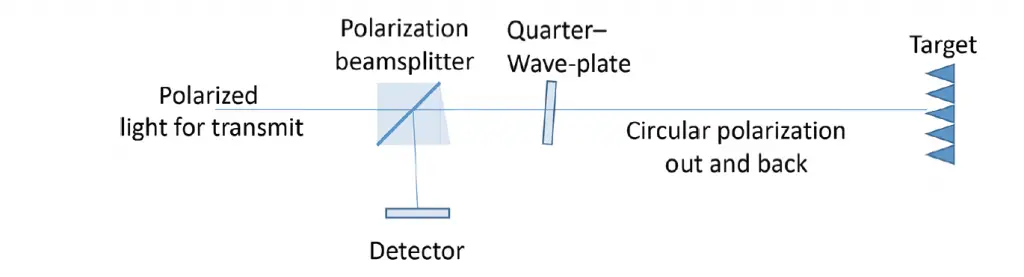
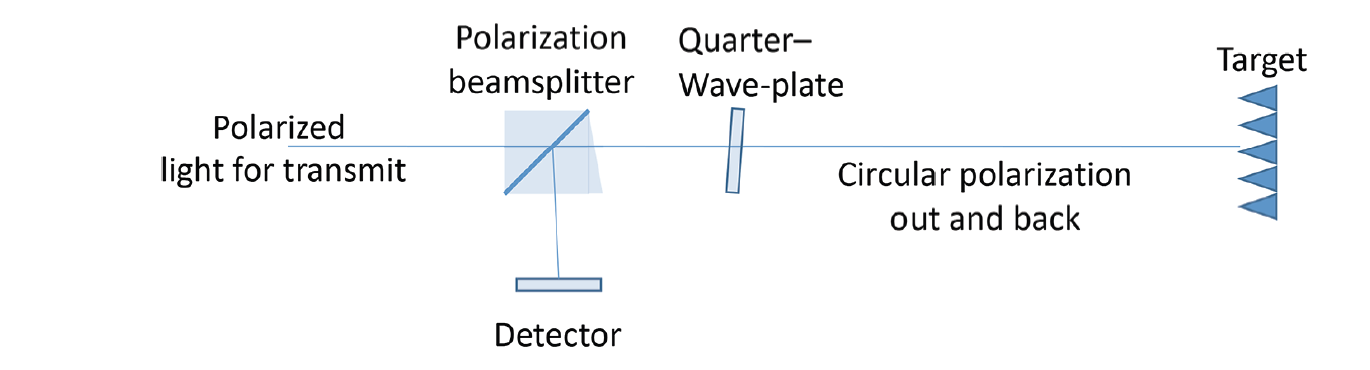
One of the most effective isolation techniques for CW and high-duty-cycle LiDAR systems is polarization-based optical isolation.
The process works as follows:
- The LiDAR transmits a linearly polarized laser beam.
- A polarizing beamsplitter (PBS) directs the transmitted beam toward the scene while rejecting orthogonally polarized light.
- A quarter-wave plate (QWP) converts the linearly polarized light into circular polarization.
- Upon reflection from a target, the circularly polarized light reverses its handedness.
- Passing back through the quarter-wave plate, the reflected beam is converted into the orthogonal linear polarization.
- This orthogonally polarized return signal is then efficiently directed by the polarizing beamsplitter into the receiver path, while transmitted laser power is rejected.
This technique typically provides 40–45 dB of isolation, corresponding to a rejection ratio of approximately 10,000 to 30,000, making it highly effective at protecting sensitive detectors.
Residual Backscatter and System Optimization
Despite high polarization isolation, some residual backscatter remains. The dominant contributors typically include:
- Scattering from the quarter-wave plate
- Reflections within the transmit telescope optics
- Surface imperfections and coating non-idealities
Through careful optical design—such as high-quality anti-reflection coatings, wedged optics, and optimized telescope layouts—these residual effects can be minimized, further enhancing receiver performance and signal fidelity.
Summary
Transmit/Receive isolation is essential for enabling high-performance LiDAR operation, especially in CW and high-duty-cycle systems. While bistatic configurations and temporal gating offer basic solutions, polarization-based isolation provides a compact, efficient, and highly effective approach. With proper optical engineering, this method significantly reduces backscatter, protects the receiver, and improves overall LiDAR system sensitivity and reliability.