
Choosing the right infrared optical material is one of the first steps when designing or sourcing an infrared window, lens, dome, or custom optical component.
Different materials perform better in different wavelength ranges, environments, and applications. Some materials are selected for wide infrared transmission, while others are chosen for strength, durability, or cost-effectiveness.
Below is a simple guide to help you understand the common infrared optical materials used in industrial, defense, thermal imaging, laser, and scientific applications.
Before You Pick a Material, Answer These Four Questions
Most material selection mistakes happen because one of these wasn’t considered early enough.
1. What wavelength range does your system need?
Infrared is split into three main bands:
- MWIR: 3–5 µm
- LWIR: 8–12 µm
This matters because some materials simply don’t transmit beyond a certain point. Silicon, for example, is completely opaque past 7 µm — so it can never be used in an LWIR system, no matter how good it looks on other parameters.
2. How harsh is the operating environment?
A laboratory window and an airborne dome face completely different threats. Rain erosion, sand, pressure, thermal shock, and humidity can all eliminate materials from the shortlist. Sapphire and ZnS handle harsh conditions well. BaF₂ and ZnSe do not.
3. Do you need a coating?
Anti-reflection (AR) coatings reduce surface reflection losses. Diamond-like carbon (DLC) coatings add scratch resistance. Not all coatings adhere equally well to all substrates, so your coating requirement can influence which material is practical.
4. How many units do you need?
Some materials, like Chalcogenide Glass, can be precision-molded at volume — which dramatically reduces cost for complex lens shapes. Others need to be individually ground and polished, which is fine for small quantities but becomes expensive at scale.
Best Material by Application
| Application | Recommended Material |
|---|---|
| MWIR window | Silicon or Sapphire |
| LWIR thermal imaging window | ZnS or ZnSe |
| Harsh outdoor dome | ZnS or Sapphire, depending on wavelength |
| CO₂ laser optics | ZnSe |
| Broadband lab window | CaF₂ or BaF₂ |
| High-volume LWIR lens | Chalcogenide Glass |
| Visible + IR multi-band system | Multispectral ZnS |
Infrared Optical Material Guide
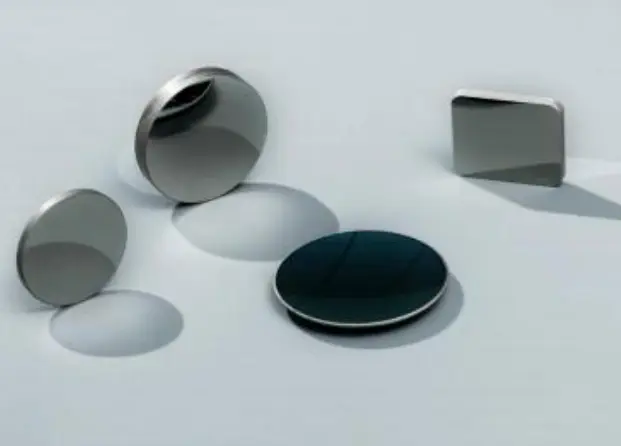
Silicon Optical Components
Silicon is commonly used for infrared windows and optical components, especially in systems where durability and stable performance are required.
It is often selected for infrared sensors, thermal imaging systems, laser systems, and protective IR windows.
Common applications:
• Infrared windows
• IR sensor protection
• Thermal imaging systems
• Laser and optical instruments
• Custom infrared optical components
Why choose Silicon?
Silicon is a good choice when a strong, reliable, and cost-effective infrared material is required for selected IR wavelength ranges. It offers good mechanical durability and is widely used in custom IR optical components for industrial, defense, and thermal imaging applications.
ZnSe Windows and Lenses
Zinc Selenide, also known as ZnSe, is widely used for infrared windows, lenses, and laser optical components. It is especially common in CO₂ laser optics and infrared transmission applications where good optical performance is required across a broad IR wavelength range.
Common applications:
• CO₂ laser optics
• Infrared windows
• IR lenses
• Thermal imaging systems
• Laser protection windows
Why choose ZnSe?
ZnSe is a good choice when an optical system requires good infrared transmission and laser compatibility. It is widely used in IR optical systems, CO₂ laser systems, and custom infrared components where stable transmission performance is important.
ZnS Optical Windows
Zinc Sulfide, also known as ZnS, is commonly used for infrared windows, protective covers, and optical domes. It is often selected when the optical component needs to support infrared transmission while also maintaining good mechanical durability.
Common applications:
• Infrared windows
• IR domes
• Protective optical covers
• Defense and surveillance systems
• Harsh environment optical components
Why choose ZnS?
ZnS is a good choice for applications where infrared performance and durability are both important. It is widely used in IR windows, domes, and protective optical components for defense, surveillance, and harsh environment applications.
Sapphire Windows
Sapphire is well known for its excellent hardness, strength, and scratch resistance. It is commonly used as a protective optical window in harsh environments where mechanical protection and environmental durability are important.
Common applications:
• Protective windows
• High-pressure optical windows
• Harsh environment covers
• Aerospace and industrial systems
• Sensor protection windows
Why choose Sapphire?
Sapphire is a good choice when the application requires high strength, scratch resistance, and long-term durability. It is often used for protective optical windows, sensor covers, and harsh environment optical components.
Chalcogenide Glass Components
Chalcogenide Glass is commonly used in infrared lens systems and molded infrared optical components. It is often selected for LWIR and thermal imaging applications where IR transmission, design flexibility, and lens manufacturability are important.
Common applications:
• Infrared lenses
• Molded IR optics
• Thermal imaging systems
• LWIR optical components
• Custom infrared assemblies
Why choose Chalcogenide Glass?
Chalcogenide Glass is a good choice for infrared lens applications where moldability, design flexibility, and IR transmission are important. It is widely used in thermal imaging lenses, LWIR optical systems, and custom infrared lens assemblies.
Infrared Optical Material Comparison Table
| Material | Common Use | Best For |
|---|---|---|
| Silicon | IR windows, sensors, laser systems | Cost-effective IR components |
| ZnSe | IR lenses, windows, CO₂ laser optics | Laser and infrared transmission |
| ZnS | IR windows, domes, protective covers | Durable IR components |
| Sapphire | Protective windows, harsh environment covers | Strength and scratch resistance |
| Chalcogenide Glass | IR lenses, molded optics | LWIR and thermal imaging lenses |
What Information Should You Provide Before Ordering?
The more information you provide upfront, the faster and more accurately a supplier can recommend the right material and process. Here’s what matters most:
- Wavelength range — which band(s) must the component transmit? (MWIR / LWIR / broadband)
- Application and environment — lab instrument, airborne sensor, ground vehicle, industrial process?
- Component type — flat window, lens, dome, prism, or blank?
- Dimensions and tolerances — diameter, thickness, surface flatness, scratch-dig specification
- Coating requirements — AR coating wavelength range, DLC for abrasion resistance, or uncoated?
- Quantity — this affects whether molding or polishing is the more practical route
- Drawing or datasheet — if you have one, share it early
Providing this upfront saves significant time and avoids the most common back-and-forth in the quoting process.
Example Specification for Infrared Optical Component
Below is an example of the information you can provide when requesting an infrared optical component quotation.
| Item | Example Specification |
|---|---|
| Material | Silicon |
| Component Type | Blanks |
| Wavelength Range | 8–12 µm |
| Shape | Round flat |
| Diameter | 25.00 mm |
| Thickness | 3.00 mm |
| Dimensional Tolerance | ±0.10 mm |
| Surface Quality | 60/40 scratch-dig |
| Surface Flatness | λ/2 @ 632.8 nm |
| Clear Aperture | ≥ 90% of diameter |
| Coating Requirement | AR coating for 8–12 µm |
| Edge / Chamfer | Protective chamfer, 0.2 mm × 45° |
| Quantity | 20 pcs |
| Drawing | Available / Not available |
Summary: How to Make the Final Choice
Here’s a simple way to narrow it down:
- Need LWIR (8–12 µm)? → ZnSe, ZnS, or Chalcogenide Glass. Silicon and Sapphire are ruled out.
- Need MWIR (3–5 µm) with maximum durability? → Silicon or Sapphire.
- Need multi-band visible + MWIR + LWIR? → Multispectral ZnS.
- Need the widest possible spectral range in a lab setting? → BaF₂ or CaF₂.
- Need high-volume molded lenses? → Chalcogenide Glass.
- Need to survive rain, sand, or abrasion? → Sapphire (MWIR only) or DLC-coated ZnS.
There is no single infrared material that is best for every application. The right choice depends on wavelength range, environment, mechanical strength, coating requirement, and final system use.
Contact Shape Optics Technologies
Shape Optics Technologies manufactures custom infrared optical components in Silicon, ZnSe, ZnS (standard and multispectral), Sapphire, CaF₂, BaF₂, and Chalcogenide Glass — including flat windows, blanks, domes, lenses, and coated assemblies.
If you’re not sure which material fits your application, send us your requirements and our engineering team will advise on material selection, tolerances, and coating options before you commit to a design.
Contact us to discuss your IR optical component requirements.