
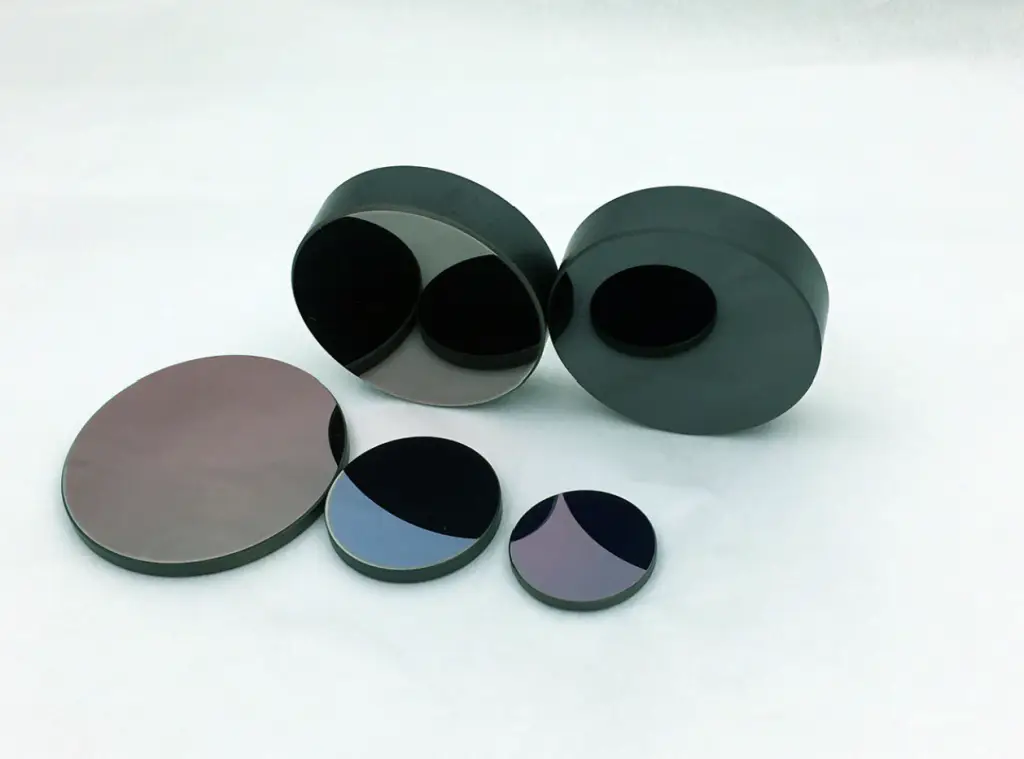
Germanium (Ge) coatings play a critical role in enhancing both optical performance and environmental durability of germanium components used in infrared (IR) systems. Due to germanium’s inherently high refractive index and sensitivity to surface damage, properly designed coatings are essential for applications ranging from thermal imaging to spectroscopy and aerospace systems.
Types of Germanium Optical Coatings
Anti-Reflective (AR) Coatings
Germanium has a very high refractive index (~4.0 at 10.6 µm), which results in high surface reflectance of approximately 35–36% per surface when uncoated. AR coatings are applied to:
- Reduce surface reflection to below 5% per surface
- Increase overall infrared transmission efficiency
- Improve system signal-to-noise ratio
AR coatings can be optimized for specific wavelength ranges such as 3–5 µm (MWIR) or 8–12 / 8–14 µm (LWIR).
Hard Carbon (Diamond-Like Carbon, DLC) Coatings
For germanium optics exposed to harsh or outdoor environments, DLC coatings are commonly used. These coatings provide:
- High surface hardness and abrasion resistance
- Protection against moisture, dust, and salt fog
- Extended service life in rugged applications
DLC coatings are frequently combined with AR layers for both optical performance and mechanical durability.
Protective Overcoatings
Protective overcoats may be applied over AR stacks to:
- Improve chemical resistance
- Reduce surface wear
- Enhance environmental stability
These coatings help maintain optical performance over long operational lifetimes.
Coating Processes for Germanium Optics
Applying coatings to germanium requires precise control due to its optical sensitivity and thermal behavior.
Physical Vapor Deposition (PVD)
- Includes sputtering and evaporation
- Commonly used for AR and multilayer thin-film coatings
- Enables accurate thickness control and wavelength targeting
Chemical Vapor Deposition (CVD)
- Used primarily for DLC coatings
- Produces dense, hard carbon layers with excellent adhesion
- Ideal for demanding environmental conditions
Spin Coating
- Occasionally used for polymer-based protective layers
- Applied where mechanical protection is required without stringent optical requirements
Properties Imparted by Germanium Coatings
- Improved IR Transmission: AR coatings minimize Fresnel reflection losses and maximize usable signal throughput.
- Enhanced Mechanical Durability: DLC and hard coatings protect against scratches, abrasion, and impact damage.
- Environmental Resistance: Coatings reduce sensitivity to moisture, oils, and contaminants that can degrade optical performance.
Shape Optics Germanium (Ge) Crystal Specifications
| Attribute | Specification |
|---|---|
| Diameter | 12 mm – 380 mm |
| Length | Customized |
| Electrical Resistivity | 0.005 – 50 Ω·cm |
| Crystal Structure | Single Crystal / Polycrystalline |
| Crystal Purity | 99.999% – 99.99999% |
| Conduction Type | N-type / P-type |
| Surface Roughness | Ra max 0.2 µm – 4.0 µm |
| Refractive Index @ 10.6 µm | 4.005 |
| Absorptance @ 10.6 µm | ≤ 0.035 |
Factory Standard – Germanium Optical Windows
- Diameter range: 2 mm – 100 mm
- Diameter tolerance: +0 / −0.05 mm
- Thickness tolerance: +0.01 / −0.03 mm
- Flatness: 1/2 λ
- Parallelism: < 3 arc min
- Surface quality: 20-10 scratch-dig (no dig)
- Edge finish: Protective bevel
- Transmission: >47.5% @ 3.7–4.8 µm (uncoated)
(Higher transmission achievable with AR coatings or custom specifications)
Contact us for manufacturing limits, coating options, or custom requirements.