
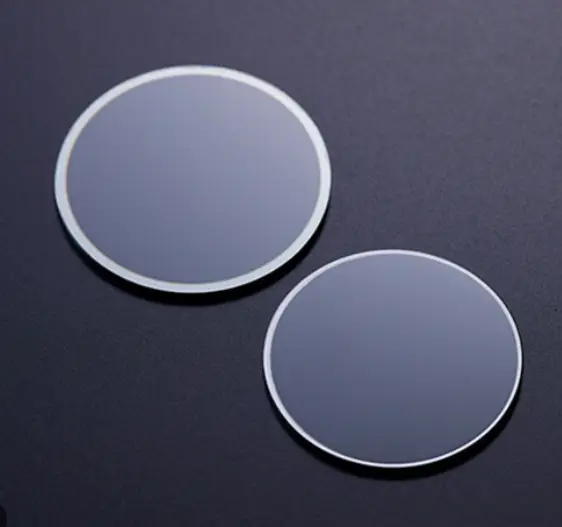
Germanium vs Chalcogenide (IRG) – DLC Coating Performance Comparison
In infrared optical systems, both Germanium (Ge) and Chalcogenide glass (IRG materials such as IRG24 and IRG26) are widely used for LWIR (8–12 µm) applications.
To improve durability, both materials are commonly coated with Diamond-Like Carbon (DLC). However, their performance, reliability, and manufacturing complexity differ significantly.
This guide compares Germanium vs IRG with DLC coating to help you choose the right material for your application.
Material Overview
Germanium (Ge)
- High refractive index (~4.0)
- Excellent LWIR transmission
- Mechanically stable and robust
- Higher density (heavier)
- Higher material cost
Chalcogenide Glass (IRG)
- Lower density (lightweight)
- Moldable for high-volume production
- Lower cost compared to Ge
- Lower hardness and thermal stability
- Increasing adoption in compact systems
DLC Coating Performance Comparison
| Performance Aspect | Germanium + DLC | IRG (Chalcogenide) + DLC |
|---|---|---|
| Adhesion | Excellent, stable | More challenging, requires optimization |
| Process Stability | Mature, repeatable | Sensitive to process control |
| Film Stress Tolerance | High | Lower (risk of deformation) |
| Surface Durability | Very high | High (significantly improved with DLC) |
| Transmission (8–12 µm) | Higher (~93–96%) | Slightly lower (~90–93%) |
| Environmental Resistance | Excellent | Good with proper coating |
| Coating Yield | High | Moderate (process dependent) |
Key Differences Explained
1. Coating Reliability
Germanium offers a more stable substrate, allowing DLC coatings to achieve:
- Strong adhesion
- Consistent results
- High production yield
IRG requires:
- Surface activation
- Adhesion layers
- Tight process control
Result: Ge is easier and more reliable to coat
2. Optical Performance
Germanium generally provides higher transmission and better optical consistency
IRG may have:
Slightly lower transmission
More sensitivity to coating stack design
For high-performance imaging, Ge still leads
3. Mechanical & Environmental Durability
- Germanium + DLC → best-in-class durability
- IRG + DLC → good durability, but depends on coating quality
DLC is essential for IRG to survive real-world conditions
4. Weight and Cost Advantage
IRG is:
Much lighter
Lower cost (especially in volume)
Germanium is:
Heavier
More expensive (especially with market volatility)
IRG is preferred for compact and cost-sensitive systems
When to Choose Germanium + DLC
Priority: Performance + reliability
- High-end thermal imaging systems
- Military / defense applications
- Long lifetime and harsh environments
- High MTF / precision optics
When to Choose IRG + DLC
Priority: Cost + weight + scalability
- Compact / lightweight devices
- High-volume production (molded optics)
- Cost-sensitive applications
- Consumer and commercial thermal cameras
Engineering Trade-Off Summary
| Priority | Recommended Material |
|---|---|
| Maximum performance | Germanium + DLC |
| Best durability | Germanium + DLC |
| Lightweight design | IRG + DLC |
| Cost efficiency | IRG + DLC |
| Mass production | IRG + DLC |
Conclusion
Both Germanium and Chalcogenide (IRG) can achieve strong performance with DLC coating—but they serve different priorities.
- Germanium + DLC → Best for performance and reliability
- IRG + DLC → Best for cost, weight, and scalability
Choosing the right combination depends on your system requirements, environmental conditions, and budget.
Need help selecting the right material and coating for your infrared optics?
Contact us today for expert support and customized solutions.