
How to Generate Ring Beams and Bessel Beams with an Axicon Lens
When combined with other optical elements, a Fused Silica Axicon Lens enables the generation of a wide variety of laser beam profiles, including collimated ring beams, variable ring-shaped focal points, and Bessel-like non-diffracting beams. This article explains how axicon lenses work, why fused silica is preferred, and how different beam profiles are achieved in practice.

What Is a Fused Silica Axicon Lens?
An axicon lens is a rotationally symmetric prism defined by its apex angle and base (alpha) angle (α). Unlike spherical or aspheric lenses, an axicon has one conical surface and one plano surface.
Because of this conical geometry, a Fused Silica Axicon Lens does not focus light to a single point. Instead, it transforms an incident Gaussian beam into a ring-shaped or Bessel-like beam along the optical axis.
Key differences from conventional lenses:
- Aspheric lens → point or line focus
- Axicon lens → ring focus or extended focus region
Beam Shaping with a Fused Silica Axicon Lens
Ring Beam Formation
When a collimated beam passes through an axicon:
- The conical surface redirects rays toward the optical axis
- Interference of these rays forms a ring-shaped intensity distribution
- The ring diameter depends on propagation distance
- The ring thickness remains constant
As the distance between the axicon and the image plane increases, the ring diameter decreases, while the ring width stays approximately equal to the input beam radius.
Bessel-Like Non-Diffracting Beams
A key application of axicon lenses is the generation of Bessel-like beams.
Unlike Gaussian beams, which diverge due to diffraction, a Bessel beam maintains its transverse intensity profile over a long propagation distance. While a true Bessel beam would require infinite energy, a Fused Silica Axicon Lens creates a close, practical approximation.
Advantages of Bessel Beams
- Near non-diffracting propagation
- Self-healing after partial obstruction
- Extended depth of focus (DOF)
Typical Applications
- Optical tweezers
- Fluorescence and light-sheet microscopy
- Medical laser processing
- Metrology and precision alignment
Depth of Focus (DOF) of an Axicon Beam
The depth of focus (DOF) of a Bessel-like beam generated by an axicon depends on:
- Input beam radius R
- Refractive index of fused silica n
- Axicon base angle α

The simplified DOF relationship (small-angle approximation) shows:
- Larger beam radius R → longer DOF
- Smaller axicon angle α → longer DOF
Note: This approximation becomes less accurate as the axicon angle increases.
Beyond the axicon’s depth of focus, a ring of light is formed. The thickness of the ring (t) remains constant and is equivalent to R:

The simplified equation again assumes small angles of refraction. The diameter of the ring is proportional to distance; increasing length from lens output to image (L) will increase the diameter of the ring (dr), and decreasing distance will decrease it.

As mathematically illustrates, the diameter of the ring is approximately related to twice the length, the tangent of the product of the refractive index (n), and the alpha angle (α).
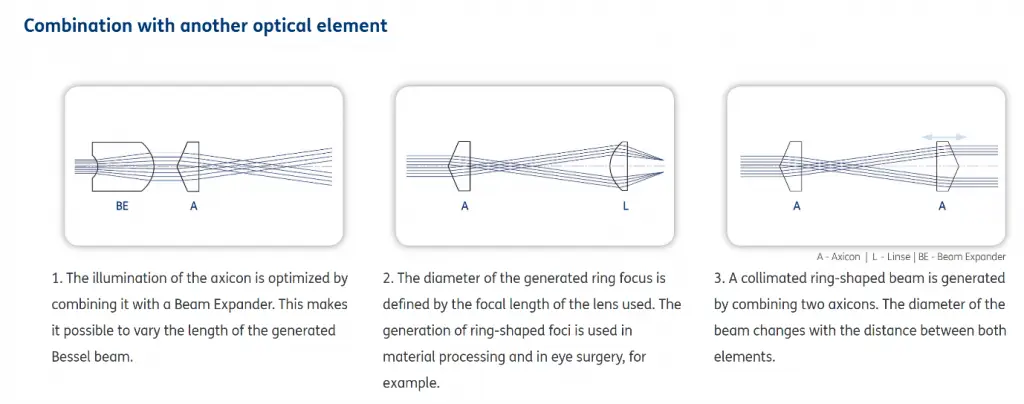
The optical effect in combination with a Beam Expander , a lens or a second Fused Slica Axicon Lens is shown below.


General Specifications – Fused Silica Axicon Lens
- Apex Round Diameter (S1): < 1 mm
- Surface Quality (S1, S2): 40/20 Scratch-Dig
- Surface Flatness (S2): < λ/10 @ 633 nm
- Surface Deviation RMS (S1): < 0.05 µm
- Surface Roughness RMS (S1): < 1 nm
- Clear Aperture: > 92% of diameter
- Angular Tolerance: ±0.02°
- AR Coating (S1, S2): R < 0.5% @ 1050 nm
- Material Options: JGS1, JGS2, Corning 7980
- Protective Chamfer: < 0.25 mm × 45°


Custom Axicon Design Support
Based on your specific application requirements, Shape Optics provides custom Fused Silica Axicon Lens designs, optimized for:
- Diameter and center thickness
- Apex and base angle
- Surface precision and coating
- Laser wavelength and power
With advanced fabrication and metrology, high angular accuracy and surface quality are guaranteed for demanding laser and imaging applications.