
Tolerancing is the process of systematically introducing errors—such as manufacturing, assembly, and material variations—into an optical system to evaluate their impact on performance. In Non-Sequential Mode (NSC), tolerancing follows different rules than sequential systems due to the physics-based nature of ray interactions (splitting, scattering, multiple reflections).
This article summarizes key considerations for non-sequential tolerancing, with an example based on a freeform lightpipe illumination system.
Key Points in Non-Sequential Tolerancing
1. Compensators and Constraints
- Compensator min/max bounds are ignored in NSC tolerancing.
- Only the Merit Function and/or User Script define valid criteria.
- To constrain compensator values, use Merit Function boundary operands (e.g., NPGT, NPLT).
2. Use of TOLR in NSC
- TOLR is supported during optimization in Non-Sequential Mode.
- User Script must be the active criterion; selecting the Merit Function as the criterion can create an infinite loop.
- Ensure that Merit Functions loaded by scripts do not themselves contain TOLR operands.
3. Disabled Sequential-Only Settings
Tolerance options that don’t apply to NSC physics—such as ray aiming, separate fields, or separate configurations—are disabled automatically.
4. Multi-Configuration Systems
When tolerancing multi-configuration NSC systems, the Merit Function must explicitly include CONF operands to account for each configuration.
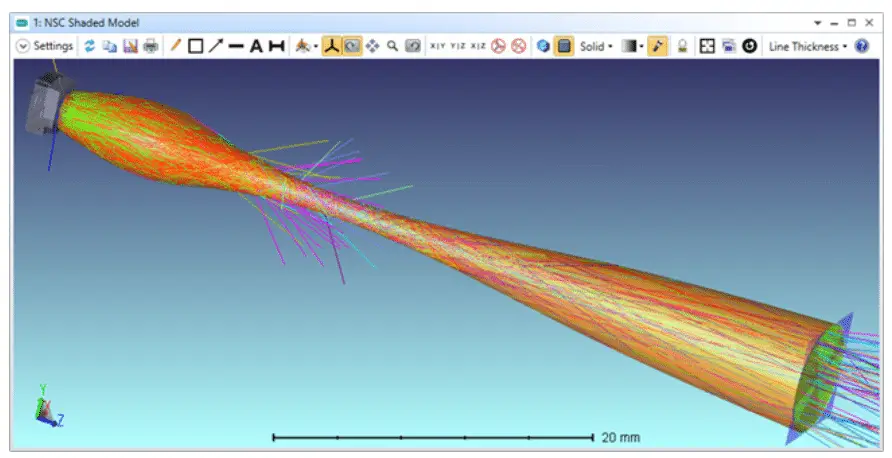
Example: Freeform Lightpipe Tolerancing
As an example, consider an optimized freeform lightpipe system consisting of:
- An OSRAM LED source
- A freeform lightpipe optimized for maximum power transfer and collimation at the detector
The tolerancing study evaluates how realistic errors affect delivered power and beam quality.
Error Categories Considered
Manufacturing Errors
- Incorrect lateral sag at freeform control points
- Incorrect overall thickness
- Incorrect refractive index
Assembly Errors
- LED position and orientation errors
- Detector position and orientation errors
These errors are introduced statistically to assess robustness of the design under production conditions.

Reporting with User Scripts
When a User Script is employed, any desired performance metric can be reported directly in the tolerance output. This is especially useful for:
- Monitoring specific detector metrics (power, uniformity, centroid)
- Tracking custom KPIs not represented by standard operands
- Ensuring production-critical values remain within limits
Practical Guidance
- Prefer User Script–driven criteria for NSC tolerancing to avoid logic conflicts.
- Use boundary operands to enforce practical limits on compensators.
- Ensure the Merit Function explicitly covers all configurations when applicable.
- Start from an over-optimized nominal design to create margin before tolerancing.
Conclusion
Non-sequential tolerancing differs fundamentally from sequential tolerancing. By respecting NSC-specific constraints—especially around compensators, scripts, and configurations—engineers can accurately predict production robustness for complex illumination systems such as freeform lightpipes.
References