
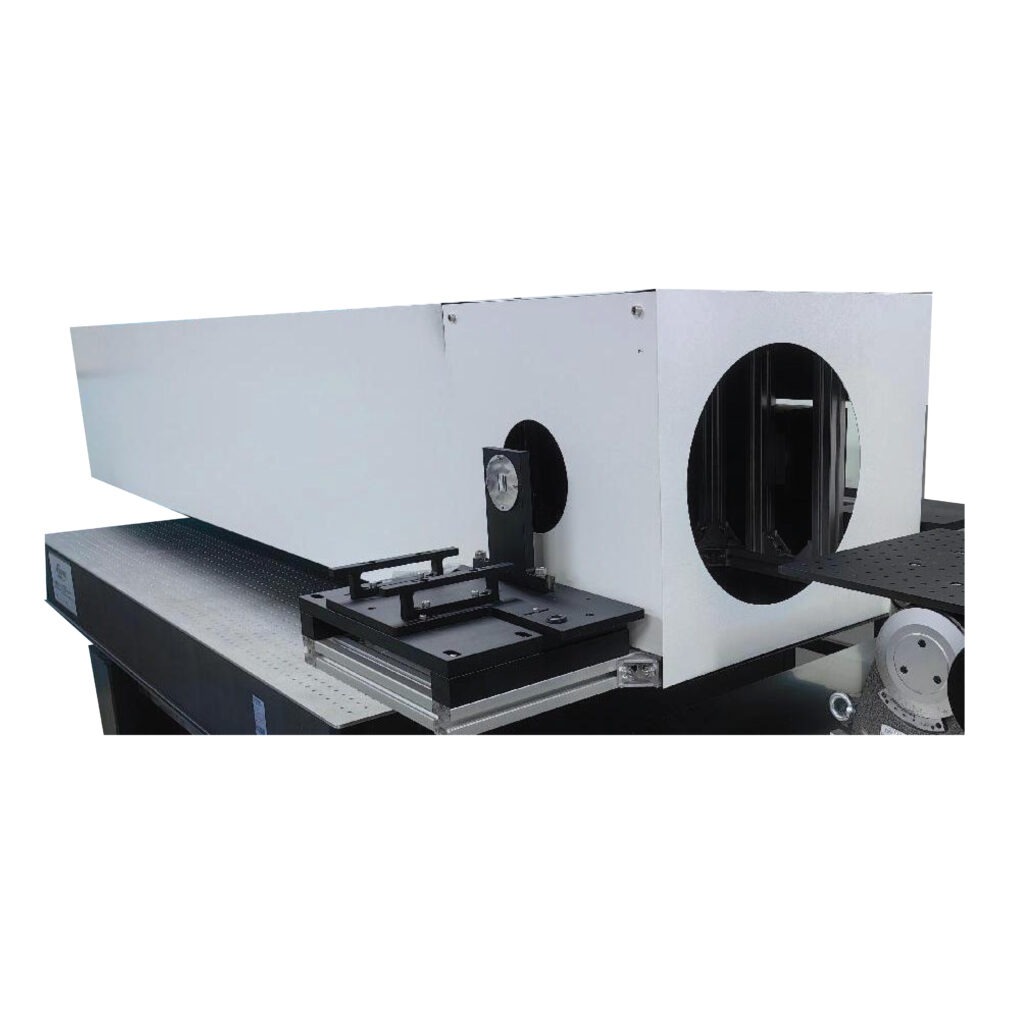
The Catadioptric Collimator is a precision optical component that combines both reflective (mirror) and refractive (lens) elements to produce a parallel beam of light. It is widely used in optical systems where collimated light is needed for precise measurements and analysis. The catadioptric design offers enhanced performance by reducing optical aberrations and improving efficiency, making it ideal for high-precision applications. This collimator ensures the parallelization of light beams, which is crucial for a range of optical testing, alignment, and calibration applications.
- Catadioptric Design: Uses both mirrors and lenses to improve optical performance and reduce aberrations.
- High Precision: Delivers accurate collimation with minimal distortion, ensuring consistent results in optical systems.
- Wide Field of View: The lens offers a large field of view (≥1.2°), making it suitable for broader applications.
- Temperature Range: Designed to operate effectively within a range of 10°C to 30°C, making it suitable for various environmental conditions.
- Clear Aperture: Offers a clear aperture of 350 mm, providing efficient light throughput.
| Model | Focal Length (mm) | Clear Aperture (mm) | Field of View | Operating Environment |
|---|---|---|---|---|
| SOT-PTGG-3 | 3000 ± 5% | 350 | 2ω ≥ 1.2° | 10°C ~ 30°C |
- Optical Testing and Calibration: Essential in testing optical systems where parallel light is required, such as in laser alignment and sensor calibration.
- Laser Systems: Used in laser collimation for ensuring a focused and parallel beam for optical experiments.
- Imaging Systems: Ideal for collimating light in imaging systems that require precise control over beam quality and direction.
- Aerospace and Defense: Used in optical testing for aerospace applications, ensuring accurate measurements and alignments.